
Facial Cleanser Formulation & Product Development
From a rough idea to a shelf-ready face wash — get end-to-end formulation strategy, surfactant science, stability testing and CDMO support for a cleanser that cleans well, feels great and stays stable.
What We Offer You
From first formula sketch to final production batch — every stage of cleanser development covered, with the technical rigour a rinse-off product actually needs.
Custom Cleanser Formulation
Bespoke cleanser formulas built around your target consumer, skin type and positioning — gel, cream, foaming, micellar, oil or balm format.
Surfactant System Design
Primary and secondary surfactant selection matched to cleansing strength, foam character, mildness and skin compatibility.
pH & Skin Compatibility
Formulating at the right pH for acid-mantle respect, preservation efficacy and long-term stability — not guesswork, measured.
Stability & Preservation Testing
Accelerated stability, freeze-thaw, challenge testing per ISO 11930 and packaging compatibility — the full validation set.
CDSCO Regulatory Support
Form COS-1 on SUGAM, labelling to Cosmetics Rules 2020, INCI compliance and claim substantiation — India-ready documentation.
CDMO Sourcing & Scale-Up
Vetted, GMP-certified manufacturers matched to your category and MOQ. Full technology transfer through pilot to commercial production.
Meet Your Product Development Expert
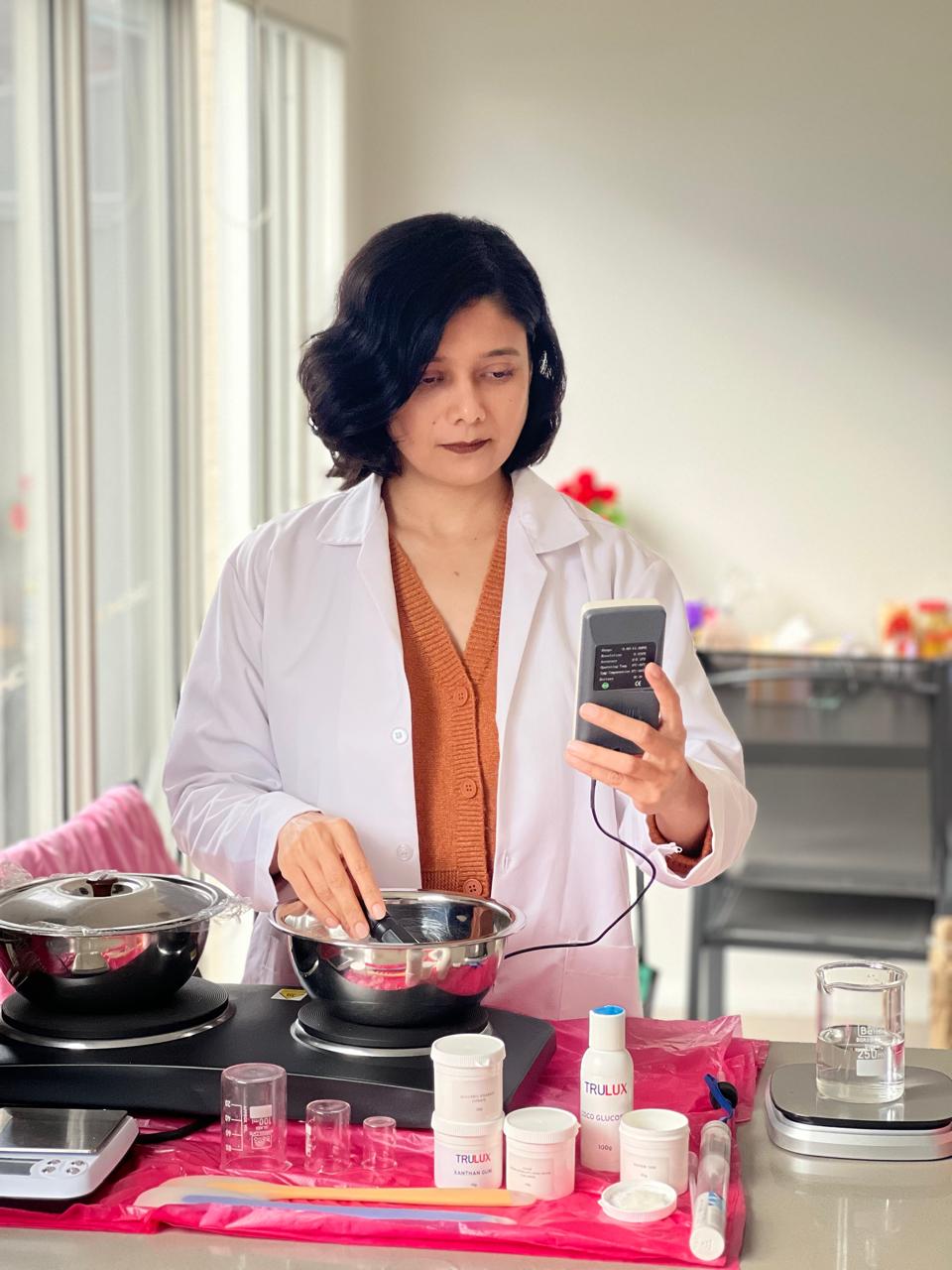
Dr. Vrushali Jagadale
Founder, Lead Consultant & Cosmetic Product Development Expert
Dr. Vrushali Jagadale is a cosmetic product development consultant, cosmetic chemist and formulation specialist who helps founders, startups, established brands, aesthetic clinics and manufacturers turn product ideas into safe, effective and commercially successful cosmetics.
Her background combines dentistry, cosmetic science and advanced aesthetic medicine, and she works across the entire product development lifecycle — concept validation, ingredient selection, custom formulation, regulatory compliance, stability testing, CDMO sourcing, production scale-up and commercial launch.
She has received international training in cosmetic formulation and product development, including professional certification from the Institute of Personal Care Science (IPCS), Australia. Her work spans cosmetic chemistry, ingredient functionality, product safety, manufacturing processes, quality assurance and global regulatory compliance.
For a facial cleanser project specifically, her expertise is most valuable when the requirement goes beyond a basic surfactant blend and calls for a genuinely well-engineered rinse-off product — one that balances foam, mildness, pH and shelf life. Read more about her work at the cosmetic product development expert page.
Why Brands Choose Us
Science-First Approach
Every formula is built on real surfactant chemistry — HLB, CMC, foam rheology, pH effects — not on trends or guesswork.
Fast Turnaround
Prototype cleansers delivered in 2–4 weeks. An established network of raw material suppliers and lab partners means no unnecessary delays.
Global Compliance Ready
Whether targeting India, EU, USA or the Middle East — the formula is designed within the regulatory boundaries of every market from day one.
End-to-End Partnership
We stay through CDMO liaison, stability testing, final QC and your first production run — not just the formula handover.
Indie-Brand Friendly
We work with early-stage founders and help match them with manufacturers who fit their production stage and budget — no minimum from us.
Clean Beauty Specialists
Deep experience in sulfate-free, natural, vegan and Ayurvedic cleanser formulation. We know which green surfactants actually work — and which don't.
What Our Clients Achieve
Measurable results from cleanser development projects — from first-time founders to established skincare brands launching new face wash lines.
Concept to shelf-ready cleanser
Full cycle: brief → surfactant selection → prototyping → stability → CDMO → first production batch. No shortcuts, no rushed batches.
Average iterations to land the right foam, glide and after-feel for a gel or cream cleanser.
ISO 11930 Criterion A — the highest preservation standard for water-based cleansers.
Formulated at skin-friendly pH — acid mantle respected, no tightness after rinsing.
Foam equivalent to sulfate baselines, without any sulfated surfactants.
CDMO sourced at the founder's actual production scale — no forced over-ordering.
Formulas compliant for India, EU, GCC and US — one formula, multiple markets.
CDSCO registration, INCI labelling and claim substantiation — submission-ready.
Ready to Master Facial Cleanser Formulation?
Join founders and brands who discovered the surfactant science, supplier network and technical strategy to bring their cleanser idea to life — without months of expensive trial and error.
How Our Consultation Process Works
A clear, structured pathway from idea to market-ready cleanser — no surprises, no scope creep.
Discovery Call
Understand your product vision, target consumer, regulatory market and budget. A 30-minute deep-dive that maps out your full cleanser scope.
Formula Strategy
Define the cleansing system — surfactant blend, foam target, pH, preservation and claim framework. You get a documented strategy.
Prototype & Testing
Lab prototypes refined through foam, viscosity and stability testing. Iterative until every benchmark is met.
Manufacturer & Launch
Match with the right CDMO, manage technology transfer and oversee your first production run to shelf-ready product.
Start Your Cleanser Project
Whether you're a first-time founder or an established brand expanding your range — book a one-on-one consultation and get expert clarity on your next cleanser.
Session Duration
30-Minute Expert Consultation | ₹2,000
What You Get
Cleanser roadmap, regulatory checklist & CDMO shortlist
Availability
Weekdays & weekends — India, GCC, Europe & UK time zones
Post-Session Support
7-day WhatsApp follow-up included with every consultation
Ready to Get Started? Let's Talk.
🔒 Every consultation is handled under strict confidentiality. NDA available on request.
Tell Us About Your Cleanser
We reply within 24 hours on business days.
Problems We Solve
From a cleanser that strips the skin to a manufacturer who won't run your batch — these are the exact problems founders bring to us every week.
Poor Foam or Lather
Cleanser that doesn't foam well, foam that collapses fast or lather that feels thin and cheap. We diagnose the surfactant blend and fix the foam profile.
Viscosity That Won't Hold
Gel cleansers that thin out over time, viscosity that drops on the shelf or thick formulas that won't dispense from the chosen pump.
Skin Stripping Feel
A cleanser that leaves skin tight, dry or irritated after rinsing — usually a surfactant, pH or over-cleansing problem.
Manufacturer Deadlock
Stuck at "MOQ too high," no response from contract manufacturers or a factory that can't replicate the formula at scale.
Compliance Gaps
Missing CDSCO documentation, incomplete INCI labelling or a cleanser that isn't cleared for the market you want to sell in.
Budget & Timeline Overruns
Cleanser projects that drag on for months with no clear roadmap or cost estimates that spiral once manufacturing begins.
Complete Cleanser Development Process
Every cleanser we develop moves through six disciplined stages — nothing skipped, nothing rushed.
Idea & Concept
Validate the cleanser idea against skin type, market demand, positioning and price band — before any ingredient is chosen.
Surfactant Research
Benchmark competitor cleansers, evaluate surfactant systems and map which combination will deliver the target foam, feel and mildness.
Formulation
Lab-scale prototype development — surfactant ratio, viscosity, pH, preservation system and sensory profile refined through multiple iterations.
Testing & Validation
Stability, microbial, preservative efficacy and packaging compatibility testing to confirm the cleanser is safe and shelf-stable.
Manufacturing & Scale-Up
Technology transfer to a matched GMP-certified manufacturer, with pilot batches checked before full production.
Launch
Regulatory sign-off, packaging brief and go-to-market support so your cleanser reaches the shelf ready to sell.
Cleanser Types We Formulate
Each cleanser format has its own surfactant logic, pH considerations, viscosity challenges and consumer expectations.
Gel Cleanser
Clear or translucent, water-based, usually foaming. Suits oily and combination skin. Relies on a surfactant blend plus a gelling agent and careful pH control.
Cream Cleanser
Opaque, lotion-like, often low-foaming. Suits dry and sensitive skin. Combines mild surfactants with emollients and humectants for a comfortable after-feel.
Foaming Cleanser
Dispensed as a foam from a pump or aerosol. Light, airy, easy to spread. Suits normal and combination skin types. Requires careful surfactant and propellant balance.
Micellar Water
Very mild surfactant solution in water. No rinsing required. Suits sensitive skin and quick cleansing. The challenge is effective cleansing with very low surfactant levels.
Cleansing Oil
Anhydrous, oil-based. Excellent for makeup removal. Works on the principle of like dissolves like. No preservative needed but needs antioxidant protection.
Cleansing Balm
Solid or semi-solid oil-based product that melts on contact with skin. Excellent for makeup removal and facial massage. Requires careful wax-oil ratio work.
The Foam Language of a Cleanser
Foam is not cosmetic. It is one of the strongest cues customers use to decide whether a cleanser "works". These five foam characters each require a different surfactant architecture.
Rich & Creamy
Dense, cushiony, slow-draining lather. Signals luxury and gentle cleansing. Typical of cream cleansers and milky face washes.
Airy & Light
Quick-draining, bubble-like, almost weightless. Common in pump-dispensed foaming cleansers and micellar foams.
Dense & Soapy
Heavy, structured, squeaky-clean feel. Strongly signals "deep cleans". Typical of oily-skin face washes with high anionic load.
Low & Silky
Minimal lather, silky glide. Signals gentle, treatment-focused cleansing. Common in sensitive-skin and post-procedure cleansers.
No Foam
Clear, watery or oil-like with zero lather. Signalling no need for foam — micellar waters and cleansing oils live here.
Why this matters: A customer who expects rich foam will reject an honest low-foam formula — even if it cleans better. Formulation has to match the foam expectation, not fight it.
Selecting Surfactants for a Facial Cleanser
Surfactant selection is the single most important technical decision in cleanser formulation. It determines cleansing strength, foam quality, mildness and rinse-off behaviour.
Anionic Surfactants
Strong cleansing, rich foam. Examples: sodium lauroyl sarcosinate, sodium laureth sulfate, sodium lauryl sulfoacetate. Can be stripping at high concentrations.
Amphoteric Surfactants
Mild to moderate cleansing, stable foam. Examples: cocamidopropyl betaine, cocamidopropyl hydroxysultaine. Generally gentle and reduce irritation from other surfactants.
Nonionic Surfactants
Very gentle, low to moderate foam. Examples: decyl glucoside, lauryl glucoside, PEG-7 glyceryl cocoate. Ideal for sensitive skin formulas.
Ingredients Used in Facial Cleanser Formulation
Surfactants
Primary cleansing function. Selected for cleansing strength, foam profile, mildness and compatibility.
Humectants
Glycerin, panthenol, hyaluronic acid — support skin feel and reduce tightness after rinsing.
Thickeners
Carbomer, xanthan gum, PEG-150 distearate — establish viscosity and flow behaviour.
Conditioning Agents
Cationic polymers, emollients and botanical extracts improve after-feel and skin comfort.
Preservatives
Protect aqueous formulas against microbial growth. Efficacy confirmed by ISO 11930 challenge testing.
pH Adjusters
Citric acid, sodium hydroxide, triethanolamine — establish and maintain the intended formulation environment.
Chelating Agents
EDTA and phytic acid bind metal ions that can catalyse oxidation and affect stability.
Fragrance & Colour
Included when compatible with the concept. Tested for stability and skin compatibility.
What Actually Goes Into a Facial Cleanser
A cleanser is built in layers. Every ingredient group plays a specific role — miss one and the product either strips the skin, foams poorly or fails preservation testing.
Purified water, humectants (glycerin, propanediol), pH adjusters. Everything else dissolves or disperses into this.
Primary anionic + secondary amphoteric + nonionic booster. This blend decides cleansing strength, foam quality and mildness.
Carbomer, xanthan gum, PEG-150 distearate, electrolytes. Establish viscosity and how the gel flows from the pump.
Cationic polymers, panthenol, botanical extracts. Shape the sensation left on the skin after rinsing.
Phenoxyethanol, sodium benzoate, potassium sorbate. Works within the formula's pH window — tested to ISO 11930.
Optional, but visible. The sensory signature your customer remembers at the sink.
Every percentage shifts based on format. A cream cleanser moves water lower and conditioning higher. A foaming cleanser pushes surfactant load up. A micellar water keeps surfactant under 5%. Getting the balance right is what formulation consulting is for.
Testing & Safety for Cleansers
Every cleanser formula is validated against the same rigorous testing standards before it goes anywhere near a production line.
Stability Testing
Accelerated and real-time stability studies at 25°C, 40°C, refrigeration and freeze-thaw cycles.
Microbial Testing
Total viable count and pathogen screening per ISO standards to confirm microbiological safety.
Challenge Testing
Preservative efficacy testing per ISO 11930 Criterion A — 3-log bacterial reduction by Day 7, no recovery through Day 28.
Packaging Compatibility
Formula-to-packaging interaction testing to prevent leaching, discolouration or degradation over shelf life.
Safety Assessment
HRIPT and dermatologist oversight for irritation and sensitisation risk on rinse-off products.
Performance Evaluation
Foam volume, foam stability, cleansing efficacy and rinse-off behaviour testing.
Regulatory & Compliance for Facial Cleansers
A great cleanser means nothing if it can't legally reach the shelf. We handle compliance for India and every major international market.
India — CDSCO & Cosmetics Rules 2020
- Form COS-1 registration on the CDSCO SUGAM portal for imported cleansers
- Form COS-2 import certificate (valid 5 years) for importers
- BIS standard IS 4707 compliance for skincare products
- INCI labelling per Cosmetics Rules 2020 requirements
- Legal Metrology declarations for weight, MRP, batch and expiry
- Claim substantiation per ASCI guidelines
International Markets
- EU Cosmetics Regulation (EC) No 1223/2009 and CPNP notification
- CPSR preparation and Product Information File
- US FDA cosmetic labelling and MoCRA compliance
- GCC / Gulf Standards Organization requirements
- UK SCPN notification for the post-Brexit market
- ASEAN, Australia (NICNAS) and other export market documentation
Cleanser Manufacturer Sourcing
Finding the right factory is often harder than developing the formula. We manage sourcing end to end.
Private Label Cleansers
Ready-made cleanser formulas you can brand as your own, with light customisation on fragrance, colour or packaging.
Contract Manufacturing
Fully custom cleanser formulas manufactured to your specification, under your brand, from a matched GMP-certified partner.
MOQ Negotiation
We negotiate minimum order quantities that work for indie brands and first-time founders — not just large orders.
Vetted Sourcing Network
Access to screened manufacturers across India and internationally, matched to your cleanser category and scale.
Tech Transfer & Liaison
We manage the handover from lab formula to factory floor, including trial batches and process documentation.
Quality Control Oversight
Batch-to-batch QC checks so what ships from the factory matches what was approved in the lab.
Facial Cleanser Formulation FAQs
Everything founders typically ask before starting a cleanser formulation project — from cost and timelines to regulatory and manufacturing.
What is facial cleanser formulation?
Facial cleanser formulation is the process of designing a skincare product that removes dirt, oil, makeup and impurities from the skin without causing unnecessary dryness or irritation. It involves surfactant selection, cleansing performance, foam profile, pH, viscosity, preservation, sensory experience and packaging compatibility.
What is the difference between a facial cleanser and a face wash?
In practice the terms are used interchangeably. Technically, a face wash is typically a foaming or gel-based cleanser, while a facial cleanser can include cream, lotion, oil, micellar water and foam formats. Formulation logic differs by format, not by the name on the label.
What surfactants are used in facial cleansers?
Common surfactants include anionics (sodium lauroyl sarcosinate, sodium laureth sulfate, sodium lauryl sulfoacetate), amphoterics (cocamidopropyl betaine), nonionics (decyl glucoside, PEG-7 glyceryl cocoate) and cationics for conditioning cleansers. The choice depends on desired cleansing strength, foam profile, mildness and skin compatibility.
How do I make a gentle facial cleanser?
Gentle cleansers use mild surfactant systems, avoid harsh sulfates at high concentrations, maintain a skin-friendly pH (typically 5.0–6.0) and include soothing or moisturising ingredients such as glycerin, panthenol or botanical extracts. Testing with real consumers is essential to confirm mildness.
What pH should a facial cleanser have?
The ideal pH depends on formulation type. Gentle cleansers typically aim for pH 5.0–5.5, close to the skin's natural pH. Soap-based cleansers tend to have pH 9.0–10.0 and can be more stripping. pH also affects preservative efficacy and ingredient stability, so it must be determined during development.
Do facial cleansers need preservatives?
Water-containing cleansers require preservation to control microbial growth. Some surfactant-based cleansers are difficult to preserve and may need careful selection of preservative systems. Challenge testing per ISO 11930 confirms whether the chosen system works.
How do I test a facial cleanser for stability?
Stability testing stores samples under controlled conditions (room temperature, elevated temperature, refrigeration, freeze-thaw cycles) and evaluates appearance, colour, odour, pH, viscosity, foam quality and physical stability over time. Accelerated testing gives early signals, but real-time data remains the reference for shelf life.
What regulatory requirements apply to facial cleansers in India?
In India, facial cleansers are regulated under the Drugs and Cosmetics Act 1940 and Cosmetics Rules 2020. Imported cleansers require registration with CDSCO through Form COS-1 on the SUGAM portal. Manufacturing requires GMP compliance. Labelling must follow INCI nomenclature with all mandatory declarations.
Can I develop a natural or organic facial cleanser?
Yes, but natural and organic formulation needs careful attention to surfactant selection, preservation and stability. Natural surfactants like glucosides are milder but foam less. Natural preservatives may be less effective and require combination with other preservation strategies. Establish the intended certification standard early.
How long does facial cleanser development take?
The timeline depends on complexity, number of prototypes, testing requirements and manufacturing considerations. A straightforward gel cleanser moves faster than a sophisticated cream cleanser with multiple actives. Plan in months rather than weeks, and allow time for stability observation and refinement.
What packaging is best for facial cleansers?
Packaging depends on the product format. Pumps and flip-top bottles suit gels and liquids. Tubes suit creams and lotions. Airless pumps protect sensitive ingredients. Jars suit thicker creams but expose the formula to contamination with each use. The choice affects stability, usability and perceived value.
What is scale-up in cleanser manufacturing?
Scale-up is transferring a laboratory cleanser formula to commercial production. Batch size, mixing equipment, heating and cooling rates and addition order can all change the finished product. Pilot batches help identify issues before full production. Documentation of process parameters ensures consistency.
Can I develop a sulfate-free facial cleanser that foams well?
Yes. Sulfate-free foam depends on choosing the right non-sulfated primary surfactant (sodium lauroyl methyl isethionate, sodium cocoyl isethionate), pairing it with foam-boosting amphoterics, and adjusting viscosity and pH. It's a technical challenge but entirely achievable with the right surfactant architecture.
Can you help if my cleanser is already failing stability or manufacturing?
Yes. Troubleshooting looks at formula, process, raw materials, packaging and storage conditions to find the underlying cause. Once the cause is understood, a targeted correction is usually far more effective than random changes.
Can a clinic or salon develop its own branded facial cleanser?
Yes. Clinics, salons and spas commonly develop branded aftercare and retail cleansers. The process is the same as for any brand: a clear brief, a suitable formula, appropriate testing, proper documentation and claims that stay within the cosmetic category.
Do I need a formula before contacting a consultant?
No. Many clients arrive with only an idea, a competitor product they like or a rough description. A consultant can turn that into a brief and then a formulation strategy. If you already have a formula, a consultant can review, improve or troubleshoot it.
Facial cleanser formulation is the process of designing a skincare product that removes dirt, oil, makeup and impurities from the facial skin without causing unnecessary dryness or irritation. It is not simply mixing a surfactant into water. A commercial cleanser has to clean effectively, foam appropriately, rinse cleanly, respect the skin's pH, stay stable for two years and pass preservation testing — all while feeling pleasant enough that the customer comes back for a second bottle.
Whether you are launching a new skincare brand, adding a cleanser to an existing range, or reformulating a face wash that is underperforming, working with an experienced facial cleanser formulation consultant can help bring the technical decisions, manufacturing requirements and market positioning together.
Facial Cleanser Formulation: The Complete Guide
Quick answer: Facial cleanser formulation designs a rinse-off product that lifts oil, dirt and makeup from the skin without stripping the barrier. It combines surfactant science, pH control, preservation, viscosity management, sensory design and regulatory compliance into one coherent formula.
Facial cleansing is the first step in almost every skincare routine, and it sets the tone for everything that follows. If the cleanser strips the skin, the moisturiser has to work harder. If it leaves residue, the serum cannot absorb properly. If it irritates, the whole routine becomes uncomfortable. That is why formulation matters more than most people realise.
The word "cleanser" covers a wide range of formats. A gel cleanser, a cream cleanser, a foaming face wash, a cleansing oil, a micellar water, a cleansing balm and a cleansing milk are all cleansers. But they are formulated according to very different logic. A gel cleanser relies on a surfactant system that foams and rinses cleanly. A cream cleanser uses a milder surfactant system combined with emollients. A cleansing oil works on the principle of like dissolves like. A micellar water uses very mild surfactants in a water base.
For a broader look at how cleanser development fits into the cosmetic product development process, read our detailed guide on cosmetic product development.
Why Facial Cleanser Formulation Is Different From Serum or Cream Formulation
A serum, a cream and a cleanser are all cosmetic products. But they are formulated according to very different principles.
A serum is a leave-on product designed to deliver active ingredients. Formulation focuses on solubility, pH, absorption, sensory feel and long-term stability. A serum that pills, feels sticky or oxidises is a failed serum, no matter how good the ingredient list looks.
A cream is also a leave-on product. Its job is to moisturise, protect and support the skin barrier. Formulation focuses on the oil phase, emulsifier system, thickeners and emollients. Texture, stability and sensory feel are critical because the product stays on the skin for hours.
A cleanser is a rinse-off product. Its job is to remove dirt, oil and makeup, then disappear down the drain. Formulation focuses on surfactant systems that clean effectively without stripping the skin. The product does not stay on the skin, so the bar for long-term skin compatibility is different. But the short-term experience — how the skin feels immediately after rinsing — matters enormously.
If your requirement is specifically formulation-focused, explore our cosmetic product formulation services for a deeper look at the technical side.
Who Needs Professional Facial Cleanser Formulation?
Professional cleanser formulation is relevant for anyone who wants a cleanser that works — not just a cleanser that exists. That includes:
- New skincare brands developing a hero cleanser from scratch.
- Established brands reformulating an existing face wash or launching a new one.
- Dermatologists and aesthetic clinics creating signature aftercare or retail cleansers.
- Private label businesses seeking customisation beyond a generic base.
- Cosmetic manufacturers needing formulation support for client projects.
- Entrepreneurs developing a differentiated hero product for a specific consumer need.
The Unique Challenges of Facial Cleanser Formulation
Cleanser formulators face challenges that do not exist in other cosmetic categories.
Cleansing vs mildness. Stronger surfactants clean more effectively but can strip the skin. Milder surfactants are gentler but may not remove heavy makeup or excess oil as efficiently. Finding the right balance is the central challenge.
Foam quality. Consumers judge cleansers by their lather. A cleanser that does not foam well feels like it is not cleaning, even if it is. Foam quality depends on surfactant selection, foam boosters and the presence of oils or conditioning agents that can suppress foam.
pH control. pH affects skin compatibility, preservative efficacy, surfactant performance and product stability. Getting it right requires understanding the chemistry of the complete system, not just picking a number.
Preservation. Water-containing cleansers are susceptible to microbial growth, but surfactants can interact with preservatives, reducing their effectiveness. Cleansers can be particularly challenging to preserve.
Regulatory complexity. Cleanser regulations differ between markets. In India, imported cleansers require CDSCO registration through Form COS-1 on the SUGAM portal, and manufacturing requires compliance with Good Manufacturing Practices under the Cosmetics Rules 2020.
Custom Facial Cleanser Formulation
Quick answer: Custom cleanser formulation develops the product around your specific concept, target consumer, cleansing preference, sensory goals, price segment, packaging format and market requirements. It does not force your idea into a generic base.
Custom formulation starts with your brief. The formulator then builds the cleanser around what you actually want the product to do. Depending on the intended product, formulation development may consider:
- Skin type and consumer profile — oily, dry, combination, sensitive, acne-prone, mature.
- Desired cleansing performance — gentle daily cleanse, deep clean, makeup removal, exfoliating.
- Target texture and sensory experience — gel, cream, foam, oil, milk, balm, micellar water.
- Ingredient preferences — natural, botanical, sulfate-free, fragrance-free, vegan.
- Intended price segment — mass, masstige, prestige, luxury.
- Packaging format — pump, tube, flip-top bottle, airless, jar, sachet.
- Manufacturing requirements — batch size, equipment, MOQ, scalability.
- Target market and regulatory considerations — India, EU, US, GCC, Southeast Asia.
Understanding Surfactants in Facial Cleanser Formulation
Quick answer: Surfactants are molecules with a water-loving head and an oil-loving tail. They reduce the surface tension between water and oil, allowing oil and dirt to be lifted and rinsed away. The type, concentration and blend of surfactants determine how a cleanser performs, how it feels and how mild it is on the skin.
How Surfactants Work on Skin
Skin produces sebum, an oily substance that helps protect the skin barrier. Dirt, pollution, makeup and dead skin cells also accumulate on the skin surface. Water alone cannot remove these because oil and water do not mix.
Surfactants solve this problem. Their molecular structure has two ends: a hydrophilic (water-loving) head and a lipophilic (oil-loving) tail. The tail attaches to oil and dirt. The head attaches to water. When the cleanser is rinsed away, the oil and dirt are carried with it.
Types of Surfactants Used in Cleansers
| Surfactant Type | Charge | Cleansing Strength | Foam Profile | Common Examples |
|---|---|---|---|---|
| Anionic | Negative | Strong | Rich, copious | Sodium lauroyl sarcosinate, sodium laureth sulfate, sodium lauryl sulfoacetate |
| Amphoteric | Both charges | Mild to moderate | Moderate, stable | Cocamidopropyl betaine, cocamidopropyl hydroxysultaine |
| Nonionic | No charge | Mild | Low to moderate | Decyl glucoside, lauryl glucoside, PEG-7 glyceryl cocoate |
| Cationic | Positive | Mild, conditioning | Low | Behentrimonium methosulfate, cetrimonium chloride |
Choosing the Right Surfactant System
The surfactant system is not just one ingredient. It is a carefully designed blend. Most cleansers use a combination of surfactants to achieve the desired balance of cleansing strength, foam quality, mildness and cost.
For example, a gentle cleanser might combine sodium lauroyl sarcosinate (mild anionic), cocamidopropyl betaine (amphoteric foam booster) and decyl glucoside (nonionic mildness enhancer). A stronger cleanser for oily skin might combine sodium laureth sulfate with cocamidopropyl betaine and a small amount of a nonionic surfactant for foam stability.
Mildness vs Cleansing Strength
There is always a trade-off between mildness and cleansing strength. Stronger surfactants clean more effectively but can strip the skin. Milder surfactants are gentler but may not remove heavy makeup or excess oil as efficiently. The formulator's job is to find the right balance for the intended consumer and skin type.
pH and Skin Compatibility in Facial Cleanser Formulation
Quick answer: The ideal pH for a facial cleanser depends on the formulation type. Gentle cleansers typically aim for pH 5.0–5.5, close to the skin's natural pH. Soap-based cleansers tend to have pH 9.0–10.0 and can be more stripping. pH also affects preservative efficacy and ingredient stability.
Why pH Matters
The skin has a natural pH of around 4.5 to 5.5, maintained by the acid mantle. This slightly acidic environment supports the skin barrier, regulates the skin microbiome and helps protect against harmful microorganisms. A cleanser with a pH that is too high can disrupt the acid mantle, leading to dryness, irritation and increased sensitivity.
pH Ranges by Cleanser Type
| Cleanser Type | Typical pH Range | Skin Compatibility Notes |
|---|---|---|
| Gentle gel cleanser | 4.5–5.5 | Close to skin's natural pH. Suitable for daily use and sensitive skin. |
| Foaming face wash | 5.0–6.0 | Mild to moderate cleansing. Good for normal and combination skin. |
| Cream cleanser | 4.5–6.0 | Gentle, moisturising. Suitable for dry and sensitive skin. |
| Soap-based cleanser | 9.0–10.0 | Higher pH can disrupt the acid mantle. Can be stripping with frequent use. |
| Micellar water | 5.0–7.0 | Very mild. pH varies by formulation. Should be close to skin pH. |
The Role of pH in Preservation
pH also affects preservative efficacy. Some preservatives are only effective within a specific pH range. For example, sodium benzoate is effective at low pH (below 5.0), while phenoxyethanol works across a wider range. When formulating a cleanser, pH must be selected with both skin compatibility and preservative performance in mind.
Facial Cleanser Testing and Validation
Quick answer: Stability testing stores cleanser samples under controlled conditions — room temperature, elevated temperature, refrigeration, freeze-thaw cycles and light exposure — and evaluates appearance, colour, odour, pH, viscosity, foam quality and physical stability over time. Preservative efficacy testing per ISO 11930 confirms the preservation system works.
Stability Testing Protocols
A cleanser that looks perfect on the day it is made can separate, discolour or lose foam quality after three months in a warm bathroom. Stability testing is how you find out before your customer does. A typical stability programme includes room temperature storage (25°C), accelerated storage (40°C at 75% RH), refrigeration (4°C), freeze-thaw cycling and light exposure.
Preservative Efficacy Testing
Water-containing cleansers require appropriate microbial control and preservation. Cleansers can be particularly challenging to preserve because surfactants can interact with preservatives, reducing their effectiveness. Challenge testing per ISO 11930 evaluates whether a preservative system can prevent microbial growth over time. Criterion A requires a 3-log reduction in bacteria by Day 7 and no recovery through Day 28.
Regulatory Considerations for Facial Cleansers in India and Internationally
Quick answer: In India, facial cleansers are regulated under the Drugs and Cosmetics Act 1940 and Cosmetics Rules 2020. Imported cleansers require registration with CDSCO through Form COS-1 on the SUGAM portal. Manufacturing requires GMP compliance. Labelling must follow INCI nomenclature and include mandatory declarations.
India: CDSCO and the Cosmetics Rules 2020
In India, facial cleansers and face washes are regulated as cosmetics under the Drugs and Cosmetics Act 1940 and Cosmetics Rules 2020. The Central Drugs Standard Control Organization (CDSCO) and state FDAs oversee compliance.
Under Rule 12(1) of the Cosmetics Rules 2020, no facial cleanser or face wash may be imported into India unless the product is registered by the Central Licensing Authority. The application is made online in Form COS-1 on the CDSCO SUGAM portal. Approval is issued as an Import Registration Certificate (Form COS-2), valid for five years.
Manufacturing premises must comply with Good Manufacturing Practices (GMP) as specified in Schedule M-II. Products must meet safety and labelling requirements including INCI nomenclature, batch number, manufacturing date, expiry date, net quantity and manufacturer details.
International Markets
In the European Union, cleansers are regulated as cosmetics under Regulation (EC) No 1223/2009, requiring a Cosmetic Product Safety Report (CPSR), a Product Information File (PIF) and CPNP notification. In the US, cleansers are regulated by the FDA under the Federal Food, Drug, and Cosmetic Act; cleansers making drug-like claims may be regulated as drugs. GCC countries follow GSO standards, and ASEAN countries have largely harmonised cosmetic regulations.
Facial Cleanser Formulation for Different Product Concepts
Different cleanser concepts require different formulation logic. A foaming facial cleanser focuses on foam generation and rinse characteristics. A gel cleanser emphasises clear appearance, viscosity and fresh application. A cream cleanser combines mild surfactants with emollients. A micellar cleanser uses very low surfactant concentrations. An acne-focused cleanser may incorporate ingredients like salicylic acid or niacinamide. A brightening cleanser requires thoughtful selection of actives suitable for a rinse-off format.
Working With Dr. Vrushali on Facial Cleanser Formulation
Dr. Vrushali is the Founder, Lead Consultant and Cosmetic Product Development Expert at Aesthetic Training India.
Her work includes cosmetic formulation, product development, cosmetic chemistry, ingredient functionality, manufacturing support and product-development strategy. She works with founders, beauty brands, professionals and businesses that need technical guidance to develop, improve or commercialise cosmetic products, including facial cleansers.
If you are developing a facial cleanser and want guidance on surfactant selection, pH, preservation or manufacturing, you can book a consultation and discuss your project.
Start Your Facial Cleanser Formulation Project
Turning a cleanser idea into a finished product takes more than picking a popular surfactant. It needs a clear concept, a suitable formulation strategy, testing, manufacturing planning and market-specific thinking. Whether you are launching a new skincare brand, developing a professional cleanser, improving an existing formula or creating a complete cleanser range, Aesthetic Training India can help you approach the development process with greater technical clarity.
If you are looking for an experienced facial cleanser formulation consultant, cosmetic formulation consultant or cosmetic product development consultancy, start by discussing your product concept and development requirements. You can also explore our cosmetic product development services for the full picture.