
Face Serum Formulation& Product Development
From a brightening concept to a shelf-ready face serum — get end-to-end serum formulation strategy, active compatibility science, stability testing and CDMO support for a serum that performs on the skin and stays stable in the bottle.
What We Offer You
From first serum active selection to final serum production batch — every stage of face serum development covered.
Custom Face Serum Formulation
Bespoke serum formulas built around your target skin concern, type and positioning — water-based, gel, emulsion, oil or anhydrous format.
Serum Active Compatibility
Choosing serum actives that work together — vitamin C with niacinamide, retinol with peptides — without conflict.
Serum pH & Solubility
Getting the serum pH right for active stability and skin tolerance. Keeping sensitive serum actives dissolved and delivered.
Serum Stability & Preservation
Accelerated serum stability, freeze-thaw, challenge testing per ISO 11930 and serum packaging compatibility.
CDSCO Regulatory Support
Form COS-1 on SUGAM, serum labelling, INCI compliance and serum claim substantiation.
Serum CDMO & Scale-Up
Vetted, GMP-certified serum manufacturers matched to your serum category and MOQ.
Meet Your Serum Formulation Expert
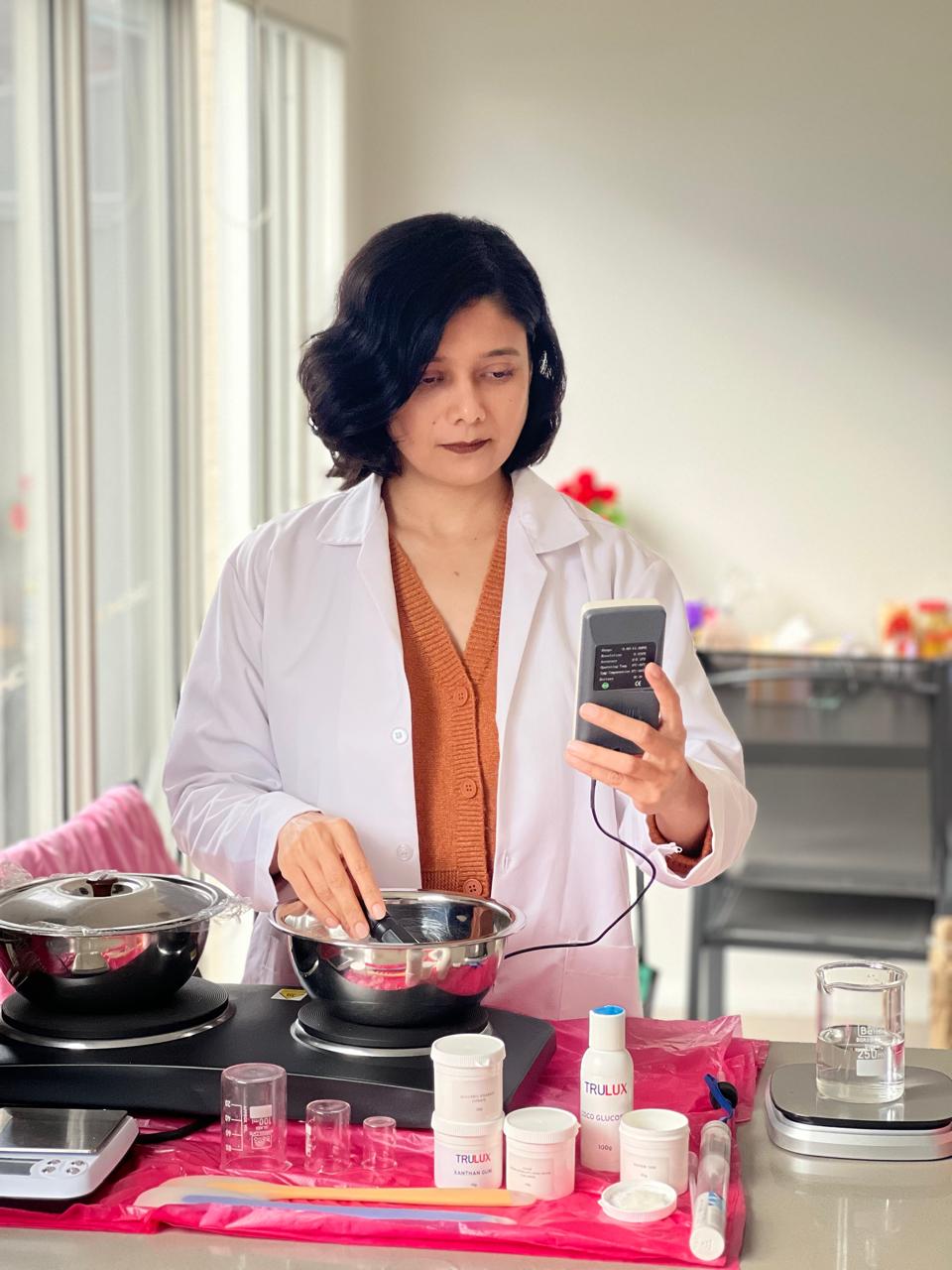
Dr. Vrushali Jagadale
Founder, Lead Consultant & Cosmetic Product Development Expert
Dr. Vrushali Jagadale is a cosmetic product development consultant, cosmetic chemist and formulation specialist who helps founders, startups, established brands, aesthetic clinics and manufacturers turn face serum ideas into safe, effective and commercially successful skincare products.
Her work spans the entire face serum development lifecycle — serum active selection, ingredient compatibility studies, custom serum formulation, regulatory compliance, serum stability testing, CDMO sourcing, production scale-up and commercial launch.
She has received international training in cosmetic formulation, including professional certification from the Institute of Personal Care Science (IPCS), Australia.
For a face serum project, her expertise matters most when the formula involves multiple actives that need to coexist without conflict — vitamin C with niacinamide, retinoids with ceramides, antioxidants with preservatives. Read more at the cosmetic product development expert page.
Why Brands Choose Us
Serum Active Science
Every formula is built on real active compatibility chemistry — solubility, pKa, degradation pathways, preservative interactions.
Fast Serum Prototyping
Prototype serums in 2–4 weeks. Established supplier and lab network means no unnecessary delays.
Global Serum Compliance
Formulas designed within the regulatory boundaries of India, EU, USA and Middle East from day one.
End-to-End Support
We stay through CDMO liaison, stability testing, final QC and your first production run.
Indie-Brand Friendly
We help match founders with manufacturers who fit their production stage and budget.
Clean Beauty Serums
Deep experience in natural, vegan and Ayurvedic serum formulation — we know which botanical actives actually perform.
Face Serum Types We Formulate
Each face serum category has its own active logic, pH window, stability challenge and consumer expectation. We formulate across the full range.
Vitamin C Face Serum
L-ascorbic acid or derivatives at the right pH, with ferulic acid and vitamin E for stability. The most demanding serum to keep photostable and non-oxidising.
Niacinamide Face Serum
Niacinamide at 2–10% for barrier support, oil control and tone evenness. Well tolerated and stable across a wider pH range than vitamin C.
Hyaluronic Acid Face Serum
Multi-molecular-weight HA blends that hydrate at different skin depths. Lightweight, fast-absorbing, ideal for all skin types including oily.
Retinol Face Serum
Encapsulated or stabilised retinol for fine lines and texture. Requires careful concentration, delivery system and packaging for stability.
Antioxidant Face Serum
Green tea, resveratrol, ferulic acid, coenzyme Q10 — protecting skin from environmental stress. Some of the most sensitive actives to formulate.
Salicylic Acid Face Serum
Salicylic acid, niacinamide and zinc combinations for oily and blemish-prone skin. pH and solubility are critical.
Peptide Face Serum
Signal and carrier peptides for firmness, elasticity and texture support. Requires careful preservation — some preservatives degrade peptides.
Alpha Arbutin Face Serum
Alpha arbutin, kojic acid, tranexamic acid and licorice extract for dark spots and uneven tone. Stability and preservative compatibility matter.
Custom Multi-Active Serum
Serums combining several actives in one bottle. The most technically demanding serum category — every active has to be compatible with every other.
How Much Active Should a Face Serum Have?
More active does not mean better. Concentration, pH, delivery and tolerance all matter. Here is the practical range for common face serum actives.
| Serum Active | Typical Concentration | pH Window | Key Stability Note |
|---|---|---|---|
| L-Ascorbic Acid (Vitamin C) | 10–20% | 3.0–3.5 | Oxidises fast — needs airless packaging and antioxidants |
| Niacinamide | 2–10% | 5.0–6.0 | Stable; above 5% may cause flushing in sensitive skin |
| Hyaluronic Acid | 0.1–2% | 5.0–7.0 | Viscosity rises fast at higher concentrations |
| Retinol | 0.1–1% | 5.0–6.0 | Light and oxygen sensitive — encapsulation recommended |
| Salicylic Acid | 0.5–2% | 3.0–4.0 | Low pH required for free-acid activity |
| Alpha Arbutin | 1–2% | 5.0–6.5 | Breaks down at high heat — cool processing |
| Peptides | 1–5% | 5.0–7.0 | Some preservatives degrade peptides — test carefully |
| Azelaic Acid | 5–10% | 4.0–5.5 | Solubility is limited — often needs derivatives |
These ranges are starting points for formulation, not universal rules. The right concentration depends on your skin-type target, regulatory market, preservative system and packaging. Over-concentration is one of the most common mistakes in DIY and small-batch serum formulation — it does not make the product stronger, it makes it less stable and less tolerable.
The Serum Layering Order That Actually Works
A face serum is used in the middle of a routine. Where it goes — and what it is layered under or over — affects how the skin absorbs it.
Cleanser
Removes oil, dirt and residue so the serum can reach the skin.
Toner / Essence
Optional prep step. Adds hydration and prepares the skin.
Face Serum
The active step. Applied on damp or dry skin depending on formula.
Moisturiser
Seals in the serum actives and protects the barrier.
Sunscreen (AM)
Always the last step in the morning. Protects skin and serum results.
Serum formulation should anticipate layering. A serum that pills under moisturiser or breaks down under sunscreen has failed the real-world test — even if the ingredient list is impressive.
How Long Before a Face Serum Shows Results?
One of the biggest misunderstandings in skincare is how quickly a face serum actually works. Here is the honest timeline.
Hydration Serums
Hyaluronic acid and glycerin serums start improving hydration within days. The effect is felt, not seen.
Niacinamide Serums
Barrier support, oil control and pore refinement start showing after the skin has adjusted.
Vitamin C & Brightening
Tone evening and dark spot fading take time. Three months is the honest measurement point.
Retinol & Anti-Aging
Fine lines, texture and firmness improve slowly. Retinol serums need patience and consistency.
Why this matters for formulation: A serum should be designed so its results build over months, not just look good on the label. Honest timelines shape honest claims.
The Serum Texture Spectrum
Serums are not just about ingredients. How the serum feels on the skin — its weight, glide, absorption speed and after-feel — is what keeps a customer coming back.
Ultra-Light
Water-thin, fast-absorbing, weightless. Suits oily skin and humid climates.
Light Gel
Refreshing, cooling, slips easily. Suits normal to oily skin.
Silky Emulsion
Balanced feel — light enough for day, rich enough to nourish.
Rich Concentrate
Substantial, cushioning, slower to absorb. Suits dry and mature skin.
Anhydrous Oil
Oil-based, no water. Excellent for barrier repair and overnight use.
Why this matters: A customer who expects a light, fast-absorbing serum will reject a rich, oily formula — even if the ingredients are excellent. Texture has to match the promise on the bottle.
Serum Active Ingredient Compatibility
Face serum formulation is about making complex ingredients work together. These are the compatibility rules that matter most.
Serum pH Conflicts
Vitamin C (low pH) and niacinamide (higher pH) need careful separation or intermediate pH. Retinol and acids should not share a formula.
Serum Solubility Limits
Some actives dissolve in water. Others need oil or co-solvents. Getting this wrong leads to precipitation or uneven distribution.
Preservative Interactions
Some serum actives reduce preservative efficacy. Others are degraded by certain preservatives. The system has to work with the actives.
What Our Clients Achieve
Measurable results from face serum development projects — from first-time founders to established skincare brands launching new serum lines.
Concept to shelf-ready serum
Full cycle: serum brief → active selection → compatibility testing → prototyping → stability → CDMO → first production batch.
Average iterations to land the right absorption, glide and after-feel for a leave-on serum.
ISO 11930 Criterion A — the highest preservation standard for water-based serums.
Formulated at skin-friendly pH — active stability respected, no sting on application.
Actives that stay effective from batch one to batch fifty.
CDMO sourced at the founder's actual production scale.
Formulas compliant for India, EU, GCC and US.
CDSCO registration, INCI labelling and claim substantiation.
Ready to Master Face Serum Formulation?
Join founders and brands who discovered the active science, supplier network and technical strategy to bring their serum idea to life — without months of expensive trial and error.
How Our Serum Consultation Works
A clear, structured pathway from idea to market-ready face serum — no surprises, no scope creep.
Serum Discovery Call
Understand your serum vision, target skin concern, regulatory market and budget. A 30-minute deep-dive.
Serum Active Strategy
Define the actives — their concentrations, compatibility, pH window and delivery system.
Prototype & Testing
Lab serum prototypes refined through absorption, viscosity and stability testing.
Manufacturer & Launch
Match with the right serum CDMO, manage technology transfer, oversee your first production run.
Start Your Face Serum Project
Whether you are a first-time founder or an established brand expanding your serum range — book a one-on-one consultation and get expert clarity on your next serum.
Session Duration
30-Minute Serum Expert Consultation | ₹2,000
What You Get
Serum formulation roadmap, regulatory checklist & CDMO shortlist
Availability
Weekdays & weekends — India, GCC, Europe & UK time zones
Post-Session Support
7-day WhatsApp follow-up included with every serum consultation
Ready to Build Your Serum? Let's Talk.
🔒 Every serum consultation is handled under strict confidentiality. NDA available on request.
Tell Us About Your Face Serum
We reply within 24 hours on business days.
Serum Problems We Solve
From a serum that oxidises too fast to a manufacturer who cannot reproduce the formula — the exact problems founders bring us every week.
Actives That Conflict
Vitamin C and niacinamide, retinol and acids, antioxidants and preservatives — combinations that fight each other in the bottle.
Sticky or Pilling Texture
Serums that feel tacky, leave a film, or pill under sunscreen and moisturiser.
Colour and Odour Shift
Vitamin C turning orange, botanical extracts changing colour, or an unpleasant smell developing on the shelf.
Manufacturer Deadlock
Stuck at "MOQ too high," no response from contract manufacturers, or a factory that cannot replicate the formula.
Compliance Gaps
Missing CDSCO documentation, incomplete INCI labelling, or a serum not cleared for your target market.
Budget & Timeline Overruns
Serum projects that drag on with no clear roadmap, or costs that spiral once manufacturing begins.
Complete Face Serum Development Process
Every face serum we develop moves through six disciplined stages — nothing skipped, nothing rushed.
Idea & Concept
Validate the serum idea against skin concern, market demand, positioning and price band — before any active is chosen.
Active Research
Benchmark competitor serums, evaluate active combinations, map which ingredients deliver the target benefit.
Formulation
Lab-scale serum prototypes — active concentration, solubility, pH, preservation and sensory profile refined iteratively.
Testing & Validation
Serum stability, microbial, preservative efficacy and packaging compatibility testing for safety and shelf life.
Manufacturing & Scale-Up
Technology transfer to a matched GMP-certified manufacturer, with pilot batches checked before full production.
Launch
Regulatory sign-off, packaging brief and go-to-market support so your serum reaches the shelf ready to sell.
Ingredients Used in Face Serum Formulation
Every ingredient in a face serum has a job — delivering an active, shaping the texture, protecting the formula, or keeping the serum stable.
Humectants
Glycerin, hyaluronic acid, propanediol, sodium PCA — attract and hold water in the skin.
Functional Actives
Vitamin C, niacinamide, retinol, peptides, alpha arbutin, azelaic acid — selected for specific benefits.
Botanical Extracts
Green tea, licorice, centella, chamomile, aloe — natural actives needing stability support.
Solvents
Water, propylene glycol, butylene glycol, ethanol — dissolve actives and shape absorption.
Preservatives
Phenoxyethanol, sodium benzoate, potassium sorbate, ethylhexylglycerin — protect water-based serums.
Chelating Agents
EDTA, phytic acid, sodium phytate — bind metal ions that degrade actives or destabilise.
pH Adjusters
Citric acid, sodium hydroxide, triethanolamine, lactic acid — establish the right pH for stability.
Antioxidants
Vitamin E, ferulic acid, coenzyme Q10, green tea catechins — protect oils and actives from oxidation.
Serum Testing & Safety Validation
Every face serum formula is validated against the same rigorous testing standards before it goes anywhere near a serum production line.
Serum Stability Testing
Accelerated and real-time studies at 25°C, 40°C, refrigeration and freeze-thaw cycles — critical for active-heavy serums.
Microbial Testing
Total viable count and pathogen screening per ISO standards to confirm serum microbiological safety.
Challenge Testing
Preservative efficacy per ISO 11930 Criterion A — 3-log bacterial reduction by Day 7, no recovery through Day 28.
Packaging Compatibility
Formula-to-packaging testing to prevent leaching, discolouration or degradation — especially for airless pumps.
Safety Assessment
HRIPT and dermatologist oversight for serum irritation and sensitisation risk on leave-on products.
Performance Evaluation
Serum absorption rate, glide, after-feel and compatibility with sunscreen and moisturiser.
Serum Regulatory & Compliance Support
A great face serum means nothing if it cannot legally reach the shelf. We handle serum compliance for India and every major international market.
India — CDSCO & Cosmetics Rules 2020
- Form COS-1 registration on the CDSCO SUGAM portal for imported face serums
- Form COS-2 import certificate (valid 5 years) for serum importers
- BIS standard compliance for serum skincare products
- Serum INCI labelling per Cosmetics Rules 2020 requirements
- Legal Metrology declarations for serum weight, MRP, batch and expiry
- Serum claim substantiation per ASCI guidelines
International Serum Markets
- EU Cosmetics Regulation (EC) No 1223/2009 and CPNP notification for serums
- CPSR preparation and Product Information File for serum formulas
- US FDA cosmetic labelling and MoCRA compliance for serums
- GCC / Gulf Standards Organization serum requirements
- UK SCPN notification for the post-Brexit serum market
- ASEAN, Australia (NICNAS) and other serum export documentation
Face Serum Manufacturer Sourcing
Finding the right factory for your face serum is often harder than developing the serum formula. We manage serum sourcing end to end.
Private Label Serums
Ready-made serum formulas you can brand as your own, with light customisation on fragrance, colour or packaging.
Contract Manufacturing
Fully custom serum formulas manufactured to your specification, from a matched GMP-certified partner.
MOQ Negotiation
We negotiate serum minimum order quantities that work for indie brands and first-time founders.
Sourcing Network
Access to screened serum manufacturers across India and internationally, matched to your category and scale.
Tech Transfer & Liaison
We manage the handover from lab serum formula to factory floor, including trial batches and documentation.
QC Oversight
Batch-to-batch serum QC checks so what ships from the factory matches what was approved in the lab.
Face Serum Formulation FAQs
Everything founders typically ask before starting a face serum formulation project — from serum actives and stability to cost and manufacturing.
What is face serum formulation?
Face serum formulation is the process of designing a skincare product with a concentrated, carefully selected combination of functional ingredients and a suitable delivery base. It involves decisions about serum active selection, compatibility, solubility, pH, texture, preservation, stability and packaging compatibility.
What is the difference between a face serum and a cream?
A face serum is typically lightweight, fast-absorbing, with a high concentration of active ingredients and lower oil content. A cream is a thicker emulsion with a higher oil phase, designed to moisturise and protect. Serums target specific concerns, while creams provide broader hydration and barrier support.
What actives can be used in a face serum?
Common face serum actives include vitamin C, niacinamide, hyaluronic acid, retinol, peptides, alpha arbutin, salicylic acid, glycolic acid, ferulic acid, coenzyme Q10, and botanical extracts like green tea, licorice and centella. The choice depends on the intended benefit, skin type and compatibility.
How do I know if serum actives are compatible?
Serum active compatibility depends on pH, solubility, charge and stability. Some actives degrade each other, some change pH, some reduce preservative efficacy. Professional serum formulation testing — compatibility studies and stability testing — confirms whether actives work together in the final formula.
What pH should a face serum have?
The ideal serum pH depends on the actives. Vitamin C serums typically require pH 3.0–3.5. Niacinamide serums are stable around pH 5.0–6.0. Hyaluronic acid serums can be formulated across a wider range, typically 5.0–7.0. pH should be determined during formulation based on active stability and skin tolerance.
Do face serums need preservatives?
Water-containing face serums require preservation to control microbial growth. Some serum actives are difficult to preserve and may need careful selection of preservative systems. Serum challenge testing per ISO 11930 confirms whether the chosen system works.
How do I test a face serum for stability?
Serum stability testing stores samples under controlled conditions (room temperature, elevated temperature, refrigeration, freeze-thaw cycles) and evaluates appearance, colour, odour, pH, viscosity and active content over time. Accelerated testing gives early signals, but real-time data remains the reference for serum shelf life.
What regulatory requirements apply to face serums in India?
In India, face serums are regulated under the Drugs and Cosmetics Act 1940 and Cosmetics Rules 2020. Imported serums require registration with CDSCO through Form COS-1 on the SUGAM portal. Manufacturing requires GMP compliance. Labelling must follow INCI nomenclature with all mandatory declarations.
Can I develop a natural or organic face serum?
Yes, but natural and organic serum formulation needs careful attention to active selection, preservation and stability. Natural serum actives like botanical extracts are often less stable and harder to preserve than synthetic alternatives. Establish the intended certification standard early.
How long does face serum development take?
The serum timeline depends on complexity, number of prototypes, testing requirements and manufacturing considerations. A straightforward hydrating serum moves faster than a multi-active anti-aging formula. Plan in months rather than weeks, and allow time for stability observation and refinement.
What packaging is best for face serums?
Airless pumps protect sensitive serum actives from air and light. Dropper bottles offer precise dispensing. Opaque or UV-blocking containers protect light-sensitive ingredients. The choice depends on the serum formula's sensitivity and the product's positioning.
What is scale-up in serum manufacturing?
Serum scale-up is transferring a laboratory serum formula to commercial production. Batch size, mixing equipment, heating and cooling rates and addition order can all change the finished serum. Pilot batches help identify issues before full production.
Can I develop a vitamin C serum that does not oxidise?
Yes. Vitamin C serum stability depends on pH, packaging, antioxidants and chelating agents. Using airless pumps, opaque bottles, ferulic acid or vitamin E as co-antioxidants, and EDTA to bind metal ions can significantly extend serum shelf life. The formula must be tested under real storage conditions.
Can you help if my serum is already failing stability or manufacturing?
Yes. Serum troubleshooting looks at formula, process, raw materials, packaging and storage conditions to find the underlying cause. Once the cause is understood, a targeted correction is usually far more effective than random changes.
Can a clinic or salon develop its own branded face serum?
Yes. Clinics, salons and spas commonly develop branded aftercare and retail face serums. The process is the same as for any brand: a clear serum brief, a suitable formula, appropriate testing, proper documentation and claims that stay within the cosmetic category.
Do I need a serum formula before contacting a consultant?
No. Many serum clients arrive with only an idea, a competitor serum they like, or a rough description. A serum consultant can turn that into a brief and then a serum formulation strategy. If you already have a serum formula, a consultant can review, improve or troubleshoot it.
Face serum formulation is the process of designing a skincare product with a concentrated, carefully selected combination of functional ingredients and a suitable delivery base. It is not simply mixing popular cosmetic ingredients. A commercial face serum has to deliver actives to the skin, stay stable for two years, pass preservation testing and feel pleasant enough that the customer comes back for a second bottle.
Whether you are launching a new skincare brand, adding a face serum to an existing range, or reformulating a serum that is underperforming, working with an experienced face serum formulation consultant can help bring the technical decisions, manufacturing requirements and market positioning together.
Face Serum Formulation: The Complete Guide
Quick answer: Face serum formulation designs a leave-on concentrate that delivers functional ingredients to the skin in a stable, pleasant, absorbable format. It combines active compatibility science, pH control, preservation, viscosity management, sensory design and regulatory compliance into one coherent formula.
Facial serums are the step in many skincare routines where concentrated actives actually reach the skin. If the serum pills under sunscreen, the moisturiser cannot do its job. If the serum actives oxidise, the product loses efficacy. If the serum texture feels sticky, the customer stops using it. That is why serum formulation matters more than most people realise.
The word "serum" covers a wide range of formats. A water-based face serum, a gel serum, an emulsion serum, an oil-based serum and an anhydrous serum are all serums. But they are formulated according to very different logic. A water-based serum relies on a soluble active system and careful preservation. An emulsion serum combines water and oil phases for a silkier feel. An oil-based serum skips water entirely but needs antioxidant protection.
For a broader look at how serum development fits into the cosmetic product development process, read our detailed guide on cosmetic product development.
Why Face Serum Formulation Is Different From Cream or Cleanser Formulation
A cream is a leave-on emulsion with a higher oil phase, designed to moisturise and protect. A cleanser is a rinse-off product, designed to remove dirt and oil. A face serum is a leave-on concentrate — lighter than a cream, more active-dense than a lotion, designed to deliver specific ingredients to the skin. The bar for serum absorption, sensory feel and active stability is higher than almost any other skincare category.
If your requirement is specifically serum formulation-focused, explore our cosmetic product formulation services for a deeper look at the technical side.
Who Needs Professional Face Serum Formulation?
Professional face serum formulation is relevant for anyone who wants a serum that works — not just a serum that exists. That includes new skincare brands developing a hero serum from scratch, established brands reformulating an existing serum, dermatologists and aesthetic clinics creating signature serums, private label businesses seeking customisation, cosmetic manufacturers needing serum formulation support, and entrepreneurs developing a differentiated serum product.
Working With Dr. Vrushali on Face Serum Formulation
Dr. Vrushali is the Founder, Lead Consultant and Cosmetic Product Development Expert at Aesthetic Training India. Her work includes face serum formulation, product development, cosmetic chemistry, active ingredient functionality, serum manufacturing support and product-development strategy.
If you are developing a face serum and want guidance on active selection, pH, preservation or serum manufacturing, you can book a serum consultation and discuss your project.
Start Your Face Serum Formulation Project
Turning a face serum idea into a finished product takes more than picking a popular active. It needs a clear serum concept, a suitable formulation strategy, serum testing, serum manufacturing planning and market-specific thinking. Whether you are launching a new skincare brand, developing a professional serum, improving an existing serum formula or creating a complete serum range, Aesthetic Training India can help you approach the serum development process with greater technical clarity.
If you are looking for an experienced face serum formulation consultant, cosmetic formulation consultant or cosmetic product development consultancy, start by discussing your serum product concept and development requirements. You can also explore our cosmetic product development services for the full picture.