Lip Balm Formulation& Lip Care Product Development
From a first concept to a shelf-ready lip balm — get end-to-end formulation strategy, wax-butter-oil balance, flavour system design, heat stability testing and CDMO support for a lip balm that glides beautifully, holds its shape and stays stable in the tube.
What We Offer You
From first wax selection to final stick hardness sign-off — every stage of lip balm development covered with the sensory and stability rigour that a lip product actually needs.
Custom Lip Balm Formulation
Bespoke lip balm formulas built around your finish, flavour and target consumer — stick, pot, tube, tinted, medicated, plumping or overnight mask format.
Wax System Design
Choosing the right wax blend for hardness, glide, payoff and heat stability — beeswax, candelilla, carnauba, ozokerite, rice bran or sunflower wax.
Butter & Oil Blending
Matching shea, cocoa, mango, kokum or murumuru butter with the right oil blend for the finish, feel and skin-compatibility you want.
Heat Stability & Melting Point
Drop point testing, heat-cool cycling and packaging stability so your lip balm does not melt in a pocket, car or Indian summer.
Flavour, Colour & Finish
Flavour oils that do not break the wax structure, tinted colours that do not migrate, and the finish — matte, satin or glossy — you promised on the label.
CDMO Sourcing & Scale-Up
Vetted, GMP-certified lip care manufacturers matched to your category and MOQ. Full technology transfer through pilot to commercial production.
Meet Your Lip Balm Formulation Expert
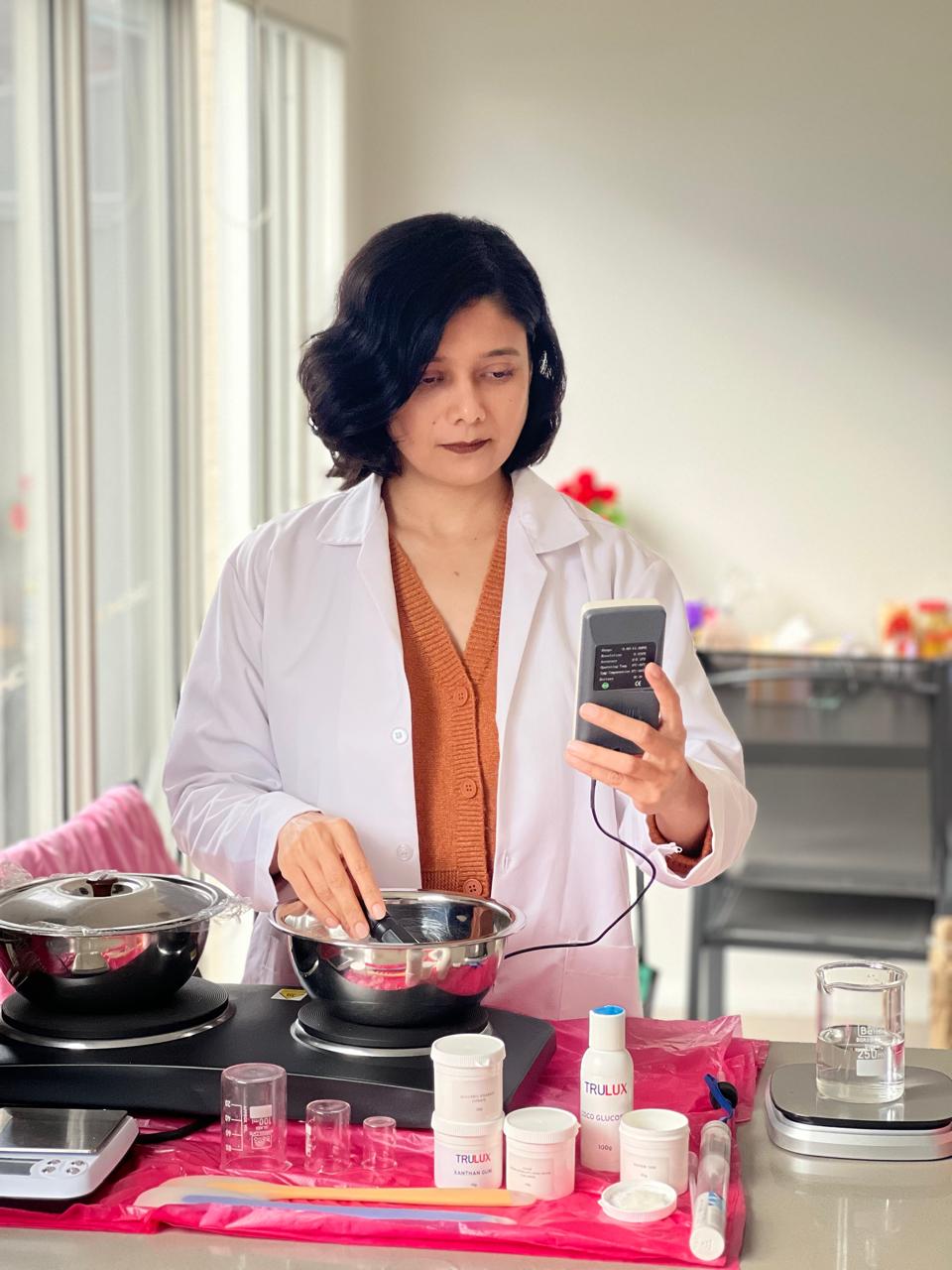
Dr. Vrushali Jagadale
Founder, Lead Consultant & Cosmetic Product Development Expert
Dr. Vrushali Jagadale is a cosmetic product development consultant, cosmetic chemist and formulation specialist who helps founders, startups, established lip care brands and manufacturers turn lip balm ideas into safe, effective and commercially successful lip products.
Her work spans the entire lip balm development lifecycle — wax system design, butter and oil blending, flavour compatibility, tinted colour development, heat stability testing, regulatory compliance, CDMO sourcing, production scale-up and commercial launch.
She has received international training in cosmetic formulation, including professional certification from the Institute of Personal Care Science (IPCS), Australia. Her expertise covers wax crystallisation, melting point engineering, sensory panel design, and the regulatory pathways that govern lip care products across India, the EU, the US and the Middle East.
For a lip balm project, her expertise matters most when the brief goes beyond a simple beeswax-shea blend and calls for a lip balm that survives Indian summer heat, holds stick shape after months on the shelf, glides without dragging, and tastes as good as it performs. Read more at the cosmetic product development expert page.
Why Brands Choose Us
Wax-Crystal Science
Every formula is built on real crystallisation chemistry — wax melting points, crystal structure, oil-binding capacity. Not on trends.
Fast Lip Balm Prototyping
Prototype lip balms in 2–3 weeks. Established wax, butter and flavour supplier network means no unnecessary waiting.
Global Lip Care Compliance
India, EU, USA, GCC — every formula is designed within the regulatory boundaries and permitted ingredient lists of each target market.
End-to-End Partnership
We stay through CDMO liaison, heat stability testing, final QC and your first production run — not just the formula handover.
Indie-Brand Friendly
We work with first-time lip care founders and match them with manufacturers who run small pilot batches — no 50,000-unit minimums.
Vegan & Natural Expertise
Deep experience in vegan, beeswax-free, petroleum-free and certified-organic lip balms. We know which wax substitutions actually work.
Lip Balm Types We Formulate
Each lip balm format has its own wax logic, sensory target, packaging constraint and consumer expectation. We formulate across the full lip care category.
Stick Lip Balm
The twist-up stick format. Requires the toughest wax-butter balance — hard enough to hold shape, soft enough to glide. The most common lip balm format globally.
Pot Lip Balm
Poured into a small jar or tin. Softer, richer, more occlusive than sticks. Popular for overnight masks and intensive treatments. Preservative-free in most formats.
Tube Lip Balm
Squeeze-tube format with a slanted applicator. Mid-soft texture, easy to apply without a mirror. Balances between stick and pot formats.
Tinted Lip Balm
Sheer, buildable colour with balm care. Uses iron oxides, mica or D&C lakes. The formulation challenge is preventing colour migration and keeping the wax structure stable.
Medicated Lip Balm
Formulated for cracked, chapped and dry lips. Often includes occlusives like petrolatum, lanolin or dimethicone alongside soothing actives like bisabolol, allantoin or panthenol.
SPF Lip Balm
UV-protective lip balm with SPF 15 or SPF 30. Uses zinc oxide, titanium dioxide or organic UV filters. Regulatory pathway is stricter because SPF is a legally tested claim.
Overnight Lip Mask
Rich, heavy, occlusive formula applied before bed. The richest category. Often includes shea, murumuru, ceramides and honey for overnight repair.
Plumping Lip Balm
Contains mild irritants like menthol, cinnamon or pepper extracts, plus hyaluronic acid spheres for a temporary plumping effect. Careful concentration is critical — too much and it burns.
Kids & Vegan Lip Balm
Fragrance-minimal, colour-free formulas for children. Vegan versions replace beeswax with candelilla, carnauba or rice bran wax. Popular for clean beauty positioning.
The Wax-Butter-Oil Triad
Every lip balm is built on three ingredient groups. The ratios between them decide everything — stick hardness, glide, payoff, heat stability and finish.
Waxes
Beeswax, candelilla, carnauba, ozokerite, rice bran. Give the balm its structure, hardness and shape retention. Higher wax = firmer stick.
Butters
Shea, cocoa, mango, kokum, murumuru. Provide richness, cushion and occlusivity. Higher butter = richer feel and slower melt.
Oils
Castor, jojoba, sweet almond, coconut, avocado, squalane. Deliver glide, absorbability and slip. Higher oil = softer balm and faster payoff.
Actives & Additives
Flavours, colourants, vitamin E, panthenol, SPF filters. Each additive shifts the wax-butter-oil balance and must be tested in the final system.
This is the central engineering challenge of lip balm formulation. Push too much wax and the balm drags on the lips. Push too much oil and it loses shape in the tube. Push too much butter and it becomes greasy. The right ratio depends on the format, the target climate, the packaging and the sensory promise on the label.
Common Waxes in Lip Balm Formulation
Each wax has its own melting point, hardness, glide and skin feel. The right choice depends on the format, climate and sensory target.
| Wax | Source | Melting Point | Typical Use Level | Notes |
|---|---|---|---|---|
| Beeswax | Animal (bee) | 62–65°C | 8–20% | Classic structural wax; excellent oil-binding; not vegan |
| Candelilla Wax | Plant (shrub) | 68–73°C | 5–12% | Vegan beeswax substitute; slightly harder; good oil retention |
| Carnauba Wax | Plant (palm) | 82–86°C | 2–5% | Very hard; adds gloss and heat resistance; used in small amounts |
| Ozokerite | Mineral | 70–80°C | 5–15% | Fossil wax; strong structure; widely used in stick balms |
| Rice Bran Wax | Plant (rice) | 75–80°C | 3–10% | Vegan; high oil-binding capacity; smooth texture |
| Sunflower Wax | Plant (sunflower) | 74–78°C | 3–8% | Vegan; excellent crystallisation control; adds rigidity |
| Cocoa Butter | Plant (cocoa) | 30–35°C | 10–25% | Technically a butter but also structural; very brittle above 15% |
| Microcrystalline Wax | Mineral | 60–90°C | 3–10% | Fossil wax; softer than ozokerite; used for flexibility |
Concentration ranges are a starting point. Every wax blend is validated in the final formula — what works for a tropical climate lip balm may fail in a pot format that gets stored in a warm bathroom.
The Lip Balm Finish Spectrum
Finish is not a bonus — it is what the customer feels the moment they swipe the balm. Different finishes need different wax-to-oil ratios, different butters and different packaging.
Matte
No shine, dry-touch finish. Higher wax, lower oil. Popular for men's lip care and matte tinted balms.
Satin
Soft, subtle sheen. Balanced wax-oil-butter ratio. The most versatile finish for daily wear.
Glossy
High-shine, almost lip-gloss effect. Higher oil and lighter wax. Popular for tinted lip balms and night masks.
Balm-to-Oil
Starts as a balm, melts on contact with lips into a light oil. Requires careful wax-polymer balance and specific packaging.
Overnight Rich
Thick, occlusive, slow-absorbing. Higher butter and petrolatum alternatives. Designed for reparative overnight use.
Why this matters: A customer who expects a glossy finish will reject a matte balm — even if the ingredients are premium. Finish has to match the promise on the label and the mood of the format.
Melting Point & Heat Stability Engineering
A lip balm that melts in a pocket, a handbag or a car in Indian summer is a failed product — no matter how well it feels on the lips in an air-conditioned room.
Drop Point Test
Measures the temperature at which the balm flows — the industry-standard heat stability metric.
45°C Oven Test
Balm kept at 45°C for 4–8 weeks. Simulates worst-case warehouse and shipping conditions.
Cycle Testing
Repeated heating and cooling cycles expose weak crystallisation that fails in real-world use.
Stick Shape Check
Post-stability check on stick deformation, shrinkage, wicking and structure collapse.
Climate Validation
Confirmation against the target market climate — Indian summer, Gulf heat, European winter.
Rule of thumb: A stick balm should hold shape up to at least 45°C for 8 weeks without deformation. A pot balm can be softer but should not separate. Both must pass real-world pocket tests, not just lab numbers.
What Our Clients Achieve
Measurable results from lip balm development projects — from first-time lip care founders to established beauty brands adding a lip balm to their range.
Concept to shelf-ready lip balm
Full cycle: lip balm brief → wax system → prototyping → heat stability → flavour design → CDMO → first production batch.
Average iterations to land the right stick hardness, glide and finish.
Stick balms hold shape through 8 weeks at 45°C without deformation.
Butter-rich formulas that still hold stick structure and glide smoothly.
Plant-wax systems that match beeswax performance without the animal source.
CDMO sourced at the founder's actual production scale — no forced over-ordering.
Formulas compliant for India, EU, US and GCC lip care frameworks.
CDSCO registration, INCI labelling and claim substantiation — submission-ready.
Ready to Build a Lip Balm That Sells?
Join founders and brands who discovered the wax-chemistry science, flavour system expertise and manufacturer network to bring their lip balm idea to life — without months of failed stick trials and melted batches.
How Our Lip Balm Consultation Works
A clear, structured pathway from idea to market-ready lip balm — no surprises, no scope creep.
Lip Balm Discovery Call
Understand your lip balm vision, target finish, flavour direction, regulatory market and budget. A 30-minute deep-dive.
Wax-Butter-Oil Strategy
Define the ingredient system — which waxes, butters and oils, at what ratio, for what climate and format.
Prototype & Heat Testing
Lab prototypes refined through sensory panels, heat stability tests, drop point testing and flavour compatibility.
Manufacturer & Launch
Match with the right lip care CDMO, manage technology transfer, oversee your first production run to shelf-ready product.
Start Your Lip Balm Project
Whether you are a first-time founder launching a lip care line or an established brand adding a lip balm to your range — book a one-on-one consultation and get expert clarity on your next lip product.
Session Duration
30-Minute Lip Balm Expert Consultation | ₹2,000
What You Get
Lip balm roadmap, heat stability checklist & CDMO shortlist
Availability
Weekdays & weekends — India, GCC, Europe & UK time zones
Post-Session Support
7-day WhatsApp follow-up included with every lip balm consultation
Ready to Build Your Lip Balm? Let's Talk.
🔒 Every lip balm consultation is handled under strict confidentiality. NDA available on request.
Tell Us About Your Lip Balm
We reply within 24 hours on business days.
Lip Balm Problems We Solve
From a stick balm that melts in the tube to a flavour that breaks the wax structure — the exact problems founders bring us every week.
Melts in the Tube
Stick balm softening, warping or collapsing at room temperature or in warmer climates — a wax system and melting point problem.
Oil Leaching / Sweating
Balm sweating oil on the surface — usually an oil-binding capacity issue with the wax blend or an over-saturated oil phase.
Grainy Texture
Graininess in cocoa butter-rich balms caused by polymorphic crystal transformation. Requires careful tempering or reformulation.
Poor Glide or Drag
Balm that tugs on the lips, drags during application, or feels like a candle. Too much hard wax and not enough oil or butter.
Flavour Breaks the Wax
Some flavour oils and essential oils disrupt wax crystallisation and cause structure collapse. Compatibility has to be tested.
Manufacturer Deadlock
No lip care manufacturer willing to run small pilot batches, or a factory that cannot reproduce the formula at scale.
Complete Lip Balm Development Process
Every lip balm we develop moves through six disciplined stages — nothing skipped, nothing rushed.
Idea & Concept
Validate the lip balm idea against finish target, flavour direction, format, price band and consumer segment — before any ingredient is chosen.
Wax-Butter-Oil Research
Benchmark competitor lip balms, evaluate wax blends, and map which combination delivers the finish, glide and heat stability you want.
Formulation
Lab-scale lip balm prototyping — wax ratio, butter selection, oil blend, flavour compatibility and tint load refined through iteration.
Testing & Validation
Drop point, heat stability, freeze-thaw, sensory panel, flavour retention and packaging compatibility testing.
Manufacturing & Scale-Up
Technology transfer to a matched lip care CDMO, with pilot batches validated before full production.
Launch
Regulatory sign-off, packaging brief and go-to-market support so your lip balm reaches the shelf ready to sell.
Ingredients Used in Lip Balm Formulation
Every ingredient in a lip balm has a job — building the stick, delivering glide, repairing the lip barrier, or adding the flavour and colour the customer expects.
Waxes
Beeswax, candelilla, carnauba, ozokerite, rice bran, sunflower — build structure and hardness.
Butters
Shea, cocoa, mango, kokum, murumuru, cupuaçu — deliver richness, cushion and occlusivity.
Oils
Castor, jojoba, coconut, sweet almond, avocado, squalane, olive — provide glide and absorbability.
Occlusives
Petrolatum, lanolin, dimethicone, candelilla-based occlusives — reduce transepidermal water loss.
Actives
Vitamin E, panthenol, allantoin, bisabolol, ceramides, honey extract — support lip repair.
Colourants
Iron oxides, mica, carmine, D&C lakes — for tinted lip balms with controlled colour payoff.
Flavours
Vanilla, mint, berry, chocolate, bubblegum, fruit — natural or synthetic flavour oils.
UV Filters
Zinc oxide, titanium dioxide, organic UV filters — for SPF lip balm formats with tested SPF claims.
Lip Balm Testing & Validation
Every lip balm we develop is validated against real-world conditions — not just a shelf test in an air-conditioned lab.
Drop Point Testing
The temperature at which the balm flows. Determines the upper heat limit of the finished product.
Heat Stability
Balm stored at 40°C and 45°C for 4–8 weeks to check for deformation, sweating or oil leaching.
Freeze-Thaw Cycling
Repeated temperature cycling exposes crystallisation weaknesses and package compatibility issues.
Sensory Panel Testing
Glide, cushion, payoff, finish, stickiness and flavour evaluated by trained sensory panelists.
Packaging Compatibility
Testing for plastic migration, tube deformation, liner compatibility and shelf-life stability.
Colour & Flavour Stability
Ensuring the tint does not migrate or fade and the flavour does not oxidise or shift on the shelf.
Lip Balm Regulatory & Compliance Support
A great lip balm means nothing if it cannot legally reach the shelf. We handle lip care compliance for India and every major international market.
India — CDSCO & Cosmetics Rules 2020
- Form COS-1 registration on the CDSCO SUGAM portal for imported lip balms
- Form COS-2 import certificate (valid 5 years) for lip care importers
- Permitted colourant list per Cosmetics Rules 2020 for tinted lip balms
- INCI labelling, batch, MRP and expiry declarations for lip balms
- Compliance with cosmetic claim language permitted for lip care in India
- SPF claim substantiation if the lip balm carries a UV protection claim
International Lip Care Markets
- EU Cosmetics Regulation (EC) No 1223/2009 — colourant and ingredient positive lists
- US FDA lip balm regulation — cosmetic vs OTC drug if SPF or healing claims made
- GCC / Gulf Standards Organization lip balm requirements
- UK SCPN notification for the post-Brexit lip care market
- ASEAN, Australia and other export market lip balm documentation
- Halal certification guidance for Middle East and Southeast Asia lip care
Lip Balm Manufacturer Sourcing
Finding the right factory for a lip balm is often harder than formulating it. Lip care requires specialised wax handling, moulding equipment and GMP discipline. We manage lip balm sourcing end to end.
Private Label Lip Balms
Ready-made lip balm formulas you can brand as your own, with light customisation on flavour, tint, packaging or finish.
Contract Manufacturing
Fully custom lip balm formulas manufactured to your specification, under your brand, from a matched GMP-certified lip care partner.
MOQ Negotiation
We negotiate lip balm MOQs that work for indie brands and first-time founders — not just large lip care orders.
Lip Care Sourcing Network
Access to screened lip balm manufacturers across India and internationally, matched to your category and scale.
Tech Transfer & Liaison
We manage the handover from lab formula to factory floor, including wax handling protocols and moulding documentation.
QC Oversight
Batch-to-batch QC checks — drop point, hardness, flavour retention — so what ships matches what was approved in the lab.
Lip Balm Formulation FAQs
Everything founders typically ask before starting a lip balm formulation project — from wax systems and flavours to cost and manufacturing.
What is lip balm formulation?
Lip balm formulation is the process of designing a lip care product that moisturises, protects and — depending on format — tints or flavoures the lips. It involves choosing the right wax blend for structure, butters and oils for emollience, actives for repair, and flavour or colour systems, then validating heat stability, glide and shelf life.
What is the difference between a lip balm and a lip gloss?
A lip balm prioritises care — moisture, barrier protection and repair. It is typically wax-heavy and less shiny. A lip gloss prioritises shine and finish, often with more oil and less wax, and usually less lip care benefit. Hybrid formats (tinted lip balms, balm-gloss) sit between the two.
Why does lip balm need wax?
Wax gives lip balm its structure. Without wax, a stick format would collapse and a pot balm would flow like oil. Wax also binds the oil phase, controls how much product transfers to the lips per swipe, and determines the melting point — the key heat stability metric.
What waxes are used in vegan lip balm?
Vegan lip balms typically use candelilla wax, carnauba wax, rice bran wax, sunflower wax or soy wax instead of beeswax. Candelilla is the most common beeswax substitute — it has a similar melting point, similar oil-binding capacity and provides comparable structure. Some vegan brands blend two or three plant waxes for better performance.
Which butters are best for lip balm?
Shea butter is the most versatile — rich but not too heavy. Cocoa butter adds structure and hardness but can cause graininess if not tempered. Mango butter is smoother and less brittle. Kokum and murumuru butters are popular in premium and vegan formulas. The best choice depends on the finish, format and climate the balm is designed for.
Why does my lip balm melt in the tube?
A lip balm that melts in the tube usually has a wax system with too low a melting point or an oil phase that is over-saturated. This can also happen if the wax was not properly crystallised during cooling. A formulator adjusts the wax blend, drops the oil percentage, or adds a small amount of a high-melting-point wax like carnauba to raise the drop point.
What causes grainy texture in lip balm?
Graininess is typically caused by cocoa butter polymorphic transformation — the fat crystallises into a stable but coarse beta form instead of the smooth beta-prime form. The fix is either tempering the cocoa butter during manufacture or replacing part of it with mango, shea or kokum butter which crystallise more smoothly.
Do lip balms need preservatives?
Most lip balms are anhydrous (no water), so they do not require preservatives. Water can be introduced through flavour extracts, hydrosols or honey, and if it is, a preservative system is required. Pot formats used with fingers have a slightly higher contamination risk than stick formats.
Can flavour oils break a lip balm formula?
Yes. Some flavour oils — especially those with high concentrations of citrus terpenes or essential oil components — interfere with wax crystallisation and cause structure collapse, oil sweating or softening. Every flavour has to be compatibility-tested in the final formula before commercial production.
How do you test lip balm heat stability?
Lip balm is tested at 40°C and 45°C for 4–8 weeks to simulate warehouse and shipping conditions, especially in Indian and Gulf markets. The stick is checked for shape retention, hardness, oil sweating, colour shift and flavour stability. Freeze-thaw cycling adds another layer of crystallisation testing.
What does drop point mean in lip balm?
Drop point is the temperature at which the lip balm flows under defined test conditions. A typical stick lip balm has a drop point between 55°C and 70°C. Higher drop point means better heat stability but can mean harder glide. Drop point is measured per ASTM D127 or AOCS Cc 18-80.
What regulatory requirements apply to lip balms in India?
In India, lip balms are regulated as cosmetics under the Drugs and Cosmetics Act 1940 and Cosmetics Rules 2020. Imported lip balms require registration with CDSCO through Form COS-1 on the SUGAM portal. Colourants must be on the permitted list, and if the balm carries an SPF claim, SPF testing and documentation are required.
Can I develop a lip balm without beeswax?
Yes. Candelilla wax, carnauba wax, rice bran wax, sunflower wax and soy wax are the main vegan substitutes. Candelilla is the closest in feel and performance to beeswax. Most vegan formulas blend two or three plant waxes to match the melting point, hardness and oil-binding capacity of beeswax.
How long does lip balm development take?
A straightforward stick lip balm to shelf-ready typically takes 3–5 months. This includes wax selection, prototype rounds, sensory panels, heat stability testing, flavour compatibility, packaging testing and CDMO transfer. SPF lip balms take longer because they require in-vivo SPF testing.
What packaging is best for lip balm?
Stick balms use twist-up tubes — plastic, aluminium or bamboo. Pot balms use small jars or tins. Tube balms use squeeze tubes with a slanted applicator. Stick tubes with a good inner seal and controlled torque give the best shape retention. All packaging must be tested for compatibility with the balm formula.
Can I develop a tinted lip balm that does not migrate?
Yes. Colour migration is controlled through the wax-to-oil ratio, pigment selection and pigment loading. Iron oxides migrate less than some organic lakes. Higher wax load and lower oil content help bind colour to the balm structure. The formula is tested with a stability panel that includes bleeding and feathering checks.
Can a clinic or salon develop its own branded lip balm?
Yes. Dermatology clinics, aesthetic clinics and salons commonly develop branded aftercare and retail lip balms. The process is the same as for any brand: a clear brief, a suitable formula, appropriate stability testing, proper documentation and claims that stay within the cosmetic category.
Do I need a lip balm formula before contacting a consultant?
No. Many lip balm clients arrive with only an idea, a competitor product they admire or a specific finish they want to achieve. A consultant can turn that into a brief and a lip balm formulation strategy. If you already have a formula, a consultant can review, improve or troubleshoot it.
Lip balm formulation is the science of designing a lip care product that protects, moisturises and — depending on format — tints or flavours the lips. It looks simple. It is not. A commercial lip balm has to glide smoothly across one of the thinnest, most exposed and most abused surfaces on the human body, hold its shape in a tube through an Indian summer, taste good without tasting chemical, look good after months on a shelf, and never, ever leave the customer with waxier lips than they started with.
Whether you are launching a new lip care brand, adding a lip balm to an existing beauty range, or reformulating a balm that is failing on heat stability, working with an experienced lip balm formulation consultant can bring the wax chemistry, sensory engineering and market positioning together.
Lip Balm Formulation: The Complete Guide
Quick answer: Lip balm formulation designs a lip care product that moisturises, protects and occludes the lips. It combines wax chemistry, butter and oil blending, active selection, flavour and colour design, heat stability engineering and regulatory claim substantiation into one coherent formula that feels good and stays stable.
Lip balm is the most underrated category in personal care. It looks simple — wax, oil, butter, maybe a flavour. But the surface it is designed for is unique. Lip skin is very different from the skin on the rest of your face, and the way it interacts with a balm is completely different from how facial skin interacts with a moisturiser.
Why Lip Balm Formulation Is Different From Any Other Skincare Category
A moisturiser is designed for facial skin — thick, layered, sebum-rich, self-protecting. A lip balm is designed for lips — thin, exposed, sebum-free and constantly under attack from sun, wind, saliva and food.
Lip skin is only three to five cellular layers thick, compared to sixteen layers on the cheeks. It has no sebaceous glands — the lips cannot moisturise themselves. It has no hair follicles, no sweat glands, and no melanin in the outermost layer, which is why lips burn and chap faster than any other part of the body.
What this means for formulation is significant. A lip balm cannot rely on the skin's own biology to finish the job. It has to do everything: occlude water loss, deliver emollience, provide structure for the stick, and still feel good on application. There is no margin for formulation errors the way there is with a face cream.
The Wax-Butter-Oil Triad: The Heart of Lip Balm Formulation
Every lip balm is a carefully engineered balance of three ingredient groups. Change the ratio and you change everything — hardness, glide, payoff, melting point, finish and shelf life.
Waxes give the balm its structure. Beeswax, candelilla, carnauba and ozokerite are the classic choices. They raise the melting point, bind the oil phase and hold the stick shape. Too much wax and the balm drags on the lips. Too little and it collapses in the tube.
Butters provide richness, cushion and occlusivity. Shea, cocoa, mango, kokum and murumuru are the main players. Cocoa butter adds hardness but tends to grain. Shea is soft and versatile. Mango is smooth. Murumuru is popular in vegan and premium formulas.
Oils deliver glide, spreadability and absorbability. Castor oil is a classic because it is thick, glossy and gives good payoff. Jojoba mimics sebum. Coconut oil is popular but oxidises fast. Sweet almond, avocado, olive and squalane are all common. The oil blend decides how the balm feels in the first three seconds on the lips.
Each of these three groups has an acceptable percentage range for each format. A stick lip balm typically uses 20–35% wax, 25–45% butter and 30–50% oil. A pot balm lowers the wax and raises the butter and oil. A squeeze tube sits in between. Everything else — flavour, colour, actives — is layered on top of that foundation.
Understanding Wax Chemistry
Not all waxes behave the same way. Beeswax is the most versatile — it has a low enough melting point to glide well, but it binds oil strongly and gives a firm stick. Candelilla wax is slightly harder and higher melting — a good vegan substitute, but it can feel drier. Carnauba is the hardest wax in use, with a melting point above 82°C. It is used in very small percentages to add heat resistance and gloss. Ozokerite is a fossil wax that provides structure without beeswax's stickiness.
The choice of wax is not just about hardness. It is about crystallisation behaviour. Waxes form crystal networks that trap oil and hold shape. Some waxes form tight, fine crystals (smooth finish). Others form coarser crystals (grainy finish, especially at higher concentrations). Blending waxes is often more effective than using one wax at high load.
Why Cocoa Butter Gets Grainy — and How to Fix It
Cocoa butter is one of the most popular lip balm butters, but it has a reputation for graininess. The reason is polymorphism. Cocoa butter can crystallise in several forms, and the smooth, desirable beta-prime form is not the most stable one. Over time, the butter transitions to a coarser beta form, which feels sandy on the lips.
The fix is either tempering during manufacture — heating and cooling on a specific schedule so the cocoa butter crystallises in the beta-prime form — or replacing part of the cocoa butter with a butter that crystallises more smoothly. Mango butter, kokum butter and shea butter do not have the same polymorphic instability as cocoa butter, so blending them in reduces the graininess risk.
Melting Point and Heat Stability
The single biggest failure mode in lip balm is heat instability. A lip balm that melts in a pocket, a handbag or a hot car is a failed product, no matter how nice it feels in an air-conditioned room.
Heat stability is engineered through the wax system. Higher melting point waxes — carnauba, ozokerite, microcrystalline wax — raise the drop point of the finished balm. Lower melting point waxes and higher oil percentages lower it. The target drop point depends on the market: an Indian summer demands a higher drop point than a European winter.
Drop point is measured per ASTM D127 or AOCS Cc 18-80. A typical stick lip balm has a drop point between 55°C and 70°C. To be safe in a hot climate, most brands target a drop point above 62°C. The formula is then validated at 40°C and 45°C for four to eight weeks, which simulates worst-case warehouse and shipping conditions.
The Role of Flavour Systems
Flavour is one of the most underestimated parts of lip balm formulation. It is not just about smell — the customer tastes the balm every time they apply it, and a bad flavour ruins an otherwise excellent formula.
Flavour oils come in natural and synthetic versions. Common profiles include vanilla, mint, berry, chocolate, honey, coconut, bubblegum and various fruit blends. Some flavour oils are fully compatible with wax systems; others interact with the crystal network and cause softening, sweating or structural collapse.
Essential oils are particularly tricky. Citrus oils, peppermint oil and eucalyptus oil have high concentrations of terpenes that can disrupt wax crystallisation. They also carry regulatory restrictions on concentration for leave-on lip products. Every flavour has to be compatibility-tested in the final formula before scale-up.
Colourants for Tinted Lip Balm
A tinted lip balm adds visible colour with balm care. Sheer, buildable and often marketed as "your lips but better." The colour system is a careful balance of pigment load, wax structure and migration resistance.
Iron oxides are the most common colourants — red, yellow and black iron oxides blended to achieve the target shade. They migrate less than organic lakes and are permitted in most markets. Carmine is used for deeper reds but is not vegan. D&C lakes (like D&C Red 7 Lake) are popular for bright shades but require careful use within permitted concentration limits.
Mica and titanium dioxide are used for pearl and shimmer finishes. Titanium dioxide also adds opacity, which is sometimes desirable and sometimes not. The pigment load has to be balanced with the wax-to-oil ratio — too much pigment and the balm feels dry and draggy; too little and the colour payoff disappears after one swipe.
Do Lip Balms Need Preservatives?
Most lip balms are anhydrous (no water), so they do not require a preservative system. Water activity is too low to support microbial growth. This is one of the reasons lip balms have relatively long shelf lives and simple ingredient lists.
However, water can be introduced through several routes: hydrosols, honey, botanical extracts dissolved in water, or concentrated flavour extracts. If the water content exceeds a certain threshold, a preservative system becomes necessary. Pot formats also carry a slightly higher contamination risk because the customer uses fingers to apply, so even mostly-anhydrous pot balms are sometimes preserved for safety.
The Vegan Lip Balm Question
Vegan lip balms replace beeswax and lanolin with plant-derived alternatives. The main substitute is candelilla wax — a plant wax from a desert shrub that has a similar melting point and oil-binding capacity to beeswax. Carnauba wax is used in small percentages for hardness and gloss. Rice bran wax and sunflower wax are also gaining popularity because they have excellent oil-binding capacity and smooth texture.
Lanolin — a sheep-derived emollient used for cracked lips — is replaced with plant butters or with synthetic occlusives. Petrolatum, another common ingredient in medicated lip balms, is technically vegan but controversial in clean beauty circles. Many brands use shea, murumuru or kokum butter as an alternative.
Formulating vegan is not just a substitution exercise. Plant waxes behave slightly differently from beeswax — candelilla is drier, carnauba is harder — so a vegan balm has to be re-engineered from the wax system up. Simply swapping beeswax for candelilla in an existing formula usually produces a balm that is too hard, too draggy or too brittle.
The Stick Format Challenge
Stick lip balm is the most difficult format to formulate. It has to hold its shape in a twist-up tube, glide smoothly on application, and survive months on a shelf or in a handbag without deforming or sweating oil.
The stick engineering involves several parameters. Stick hardness — measured as penetration value or by a simple needle test — determines how much product transfers to the lips per swipe. Payoff — the amount of balm left on the lips after one pass — is a critical sensory metric. Sweating — oil rising to the surface of the stick — is a wax-binding failure. Shrinkage — the stick pulling away from the tube wall — is a crystallisation issue.
Each of these is controlled by the wax-to-butter-to-oil ratio, the choice of specific waxes and butters, the cooling rate during manufacture and the inner diameter of the packaging tube. Successful stick formulations are the result of iterating across all these parameters.
Pot and Tube Formats
Pot balms are much easier to formulate because they do not need to hold shape. The wax load can be lower, the butter and oil loads higher, and the finish can be richer. Overnight lip masks and intensive treatments are usually pot formats for this reason.
Squeeze tube balms sit in between. They need enough wax to hold a soft solid shape but enough oil for easy extrusion. The slanted applicator is standard. Tubes are more hygienic than pots and more convenient than sticks for some consumers.
Testing Lip Balm Stability
Lip balm testing goes far beyond simple shelf-life checks. Heat stability at 40°C and 45°C for four to eight weeks checks for stick deformation, oil sweating, colour shift, flavour degradation and package compatibility. Freeze-thaw cycling — typically three to five cycles from -10°C to 25°C — exposes crystallisation weaknesses and stress fractures.
Sensory panels evaluate glide, cushion, payoff, finish, stickiness, flavour and lip feel. Trained panelists score each parameter on a scale, and the formula is refined based on the feedback. This is where the difference between a good balm and a great one is decided.
Drop point testing per ASTM D127 or AOCS Cc 18-80 confirms the melting behaviour of the finished product. Stick hardness testing via penetrometer or needle punch test confirms the mechanical strength. Packaging compatibility testing runs in parallel to check for plastic migration, deformation or liner interaction.
Regulatory Framework for Lip Balms
In India, lip balms are cosmetics under the Cosmetics Rules 2020. Imported lip balms require registration with CDSCO through Form COS-1 on the SUGAM portal. Colourants must be on the permitted list — a critical restriction for tinted lip balms. SPF claims are only permitted with in-vivo SPF testing documentation.
In the EU, lip balms fall under Regulation (EC) No 1223/2009. The EU has an extensive positive list of permitted colourants and a negative list of prohibited ingredients. Cosmetic Product Safety Report (CPSR) and Product Information File (PIF) are mandatory. The EU also has specific restrictions on fragrance allergens that must be declared on the label.
In the US, lip balms are cosmetic if they claim moisturising and OTC drug if they claim SPF, healing, or "cures chapped lips." This distinction is important — the US FDA treats OTC lip balms as drugs, requiring a different regulatory pathway.
In the Gulf and Southeast Asia, GCC Standards and ASEAN Cosmetic Directive govern lip balms with their own lists and requirements. Halal certification is often important for these markets, requiring documentation on ingredient sourcing and manufacturing hygiene.
Common Lip Balm Formulation Mistakes
- Over-relying on one wax. Single-wax systems rarely match the performance of a two or three wax blend.
- Ignoring flavour compatibility. A flavour that breaks the wax structure is a formula killer, not a nice-to-have.
- Too much cocoa butter. Cocoa butter is popular but causes graininess at higher loads. Balance it with mango, shea or kokum.
- Skipping heat stability. Short-term appearance is not stability. Only 40°C/45°C testing reveals what happens in real markets.
- Wrong packaging for the balm. A soft balm in a loose tube will collapse. A hard balm in a tight tube will not payoff.
- Testing only in a lab. Real-world pocket, handbag and car tests reveal failures lab testing misses.
- Underestimating tint load. Too much pigment makes the balm dry and draggy. Tinted balms are stickier formulation challenges than untinted ones.
- Reformulating without understanding crystallisation. Small wax changes can dramatically shift the finished product.
Working With Dr. Vrushali on Lip Balm Formulation
Dr. Vrushali is the Founder, Lead Consultant and Cosmetic Product Development Expert at Aesthetic Training India. Her work includes lip balm formulation, wax chemistry, butter and oil blending, flavour compatibility testing and lip care manufacturing support.
If you are developing a lip balm and want guidance on wax selection, heat stability, flavour systems or lip care manufacturing, you can book a lip balm consultation and discuss your project.
Start Your Lip Balm Formulation Project
Turning a lip balm idea into a finished, tested and shelf-ready product takes more than picking a beeswax-shea recipe. It needs a clear concept, a wax system built for the format and climate, a flavour and colour direction that survives testing, heat stability validation, packaging selection and a manufacturing partner who can reproduce the formula batch after batch.
Whether you are launching a new lip care brand, adding a lip balm to an existing beauty range, developing a clinical lip treatment, or reformulating a balm that is failing on stability, Aesthetic Training India can help you approach the development process with greater technical clarity.
If you are looking for an experienced lip balm formulation consultant, cosmetic formulation consultant or lip care product development consultancy, start by discussing your lip balm concept and development requirements. You can also explore our cosmetic product development services for the full picture.