
Sunscreen Formulation& SPF Product Development
From a first SPF concept to a lab-tested, market-cleared sunscreen — get end-to-end formulation strategy, UV filter selection, photostability testing, SPF/PA substantiation and CDMO support for a sunscreen that protects on the skin and stays stable in the tube.
What We Offer You
From first UV filter screen to final SPF claim sign-off — every stage of sunscreen development covered with the photostability rigour that a suncare product actually demands.
Custom Sunscreen Formulation
Bespoke sunscreen formulas built around your target SPF, PA rating, skin feel and market — lotion, gel, cream, spray, stick or tinted format.
UV Filter Selection & Blends
Choosing organic UV filters, inorganic UV filters or hybrid blends matched to SPF target, UVA-PF requirement, photostability and skin compatibility.
Photostability & Efficacy
Photostability testing, in-vivo SPF, in-vitro SPF, UVA-PF (PA rating), critical wavelength and broad-spectrum claim verification.
Water & Sweat Resistance
Water resistance testing per COLIPA / FDA protocols. 40-minute and 80-minute water resistance claims substantiated with lab data.
CDSCO & Global Regulatory
Form COS-1 on SUGAM, sunscreen labelling, INCI listing, SPF/PA claim documentation — India, EU, US, Australia, GCC-ready.
CDMO Sourcing & Scale-Up
Vetted, GMP-certified suncare manufacturers matched to your sunscreen category and MOQ. Full technology transfer to commercial production.
Meet Your Sunscreen Formulation Expert
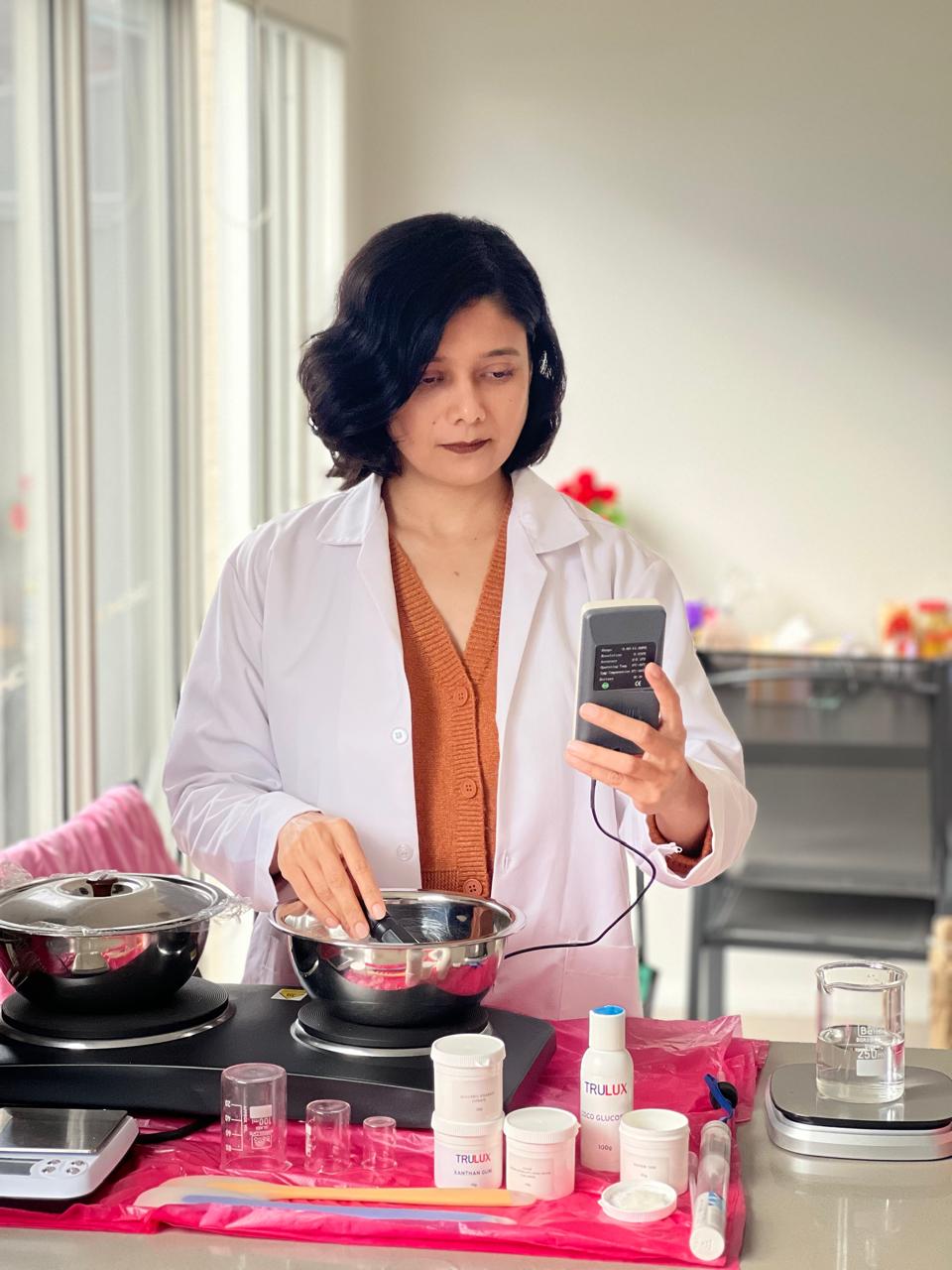
Dr. Vrushali Jagadale
Founder, Lead Consultant & Cosmetic Product Development Expert
Dr. Vrushali Jagadale is a cosmetic product development consultant, cosmetic chemist and formulation specialist who helps founders, startups, established suncare brands, dermatology clinics and manufacturers turn sunscreen ideas into safe, effective and legally marketable suncare products.
Her work spans the entire sunscreen development lifecycle — UV filter selection, sunscreen formulation, photostability testing, SPF and PA claim substantiation, water resistance validation, regulatory submission, CDMO sourcing, production scale-up and commercial launch.
She has received international training in cosmetic formulation, including professional certification from the Institute of Personal Care Science (IPCS), Australia. Her expertise covers UV filter chemistry, organic and inorganic filter compatibility, avobenzone photostabilisation, micronised and nano mineral dispersions, and the regulatory frameworks that govern suncare claims globally.
For a sunscreen project, her expertise matters most when the brief goes beyond a basic UV filter blend and calls for a sunscreen that meets a specific SPF and PA claim, passes water resistance, survives real-world sun exposure without losing efficacy, and feels pleasant enough that customers actually apply enough of it. Read more at the cosmetic product development expert page.
Why Brands Choose Us
UV Filter Science
Every sunscreen is built on real UV filter chemistry — absorbance spectra, photostability, filter synergy and skin compatibility. Not on trends.
Fast Sunscreen Prototyping
Prototype sunscreens delivered in 3–4 weeks. Established UV filter supplier and lab network means no unnecessary waiting on raw material.
Global Suncare Compliance
India, EU, USA, Australia, GCC. Every formula is designed within the regulatory filter list and labelling boundary of each target market.
End-to-End Suncare Support
We stay with you through CDMO liaison, photostability testing, SPF claim verification, final QC and your first production run.
Indie-Brand Friendly
We help match first-time suncare founders with manufacturers who can run small pilot batches without forcing a 50,000-unit MOQ.
Reef-Safe & Mineral Expertise
Deep experience in mineral-only, reef-safe, nano-free and hybrid sunscreens. We know which filter blends actually pass SPF testing without compliance headaches.
Sunscreen Types We Formulate
Each sunscreen format has its own filter logic, sensory target, SPF testing pathway and consumer expectation. We formulate across the full suncare category.
Mineral Sunscreen
Zinc oxide and titanium dioxide only. UV protection by physical scattering and absorption. Preferred for sensitive skin, infants and reef-safe positioning.
Chemical Sunscreen
Organic UV filters that absorb UV and convert it to heat. Lightweight feel and clear finish. Avobenzone, octinoxate, octocrylene, bemotrizinol and others.
Hybrid Sunscreen
Combination of organic and inorganic filters. Balances the sensorial benefits of organic filters with the broad-spectrum protection of mineral filters.
Gel Sunscreen
Water-light gel formula. Cooling, fast-absorbing, non-greasy. Popular in India and Southeast Asia for oily and acne-prone skin. Filter solubility is critical.
Cream Sunscreen
Rich, moisturising sunscreen lotion or cream. Popular for dry skin and body suncare. Balances UV protection with emollients and humectants.
Tinted Sunscreen
Pigmented sunscreen that provides visible coverage alongside UV protection. Often combines iron oxides that also protect against visible light and blue light.
Sunscreen Spray
Continuous spray or pump spray. Convenient for body and reapplication. Requires careful propellant and nozzle selection. Regulatory scrutiny on inhalation.
Sunscreen Stick
Anhydrous stick format. Popular for face, lips, under-eyes and kids. High filter load possible but requires careful wax and oil balance for glide.
Baby Sunscreen
Formulated with extra caution for infant skin. Mineral-first, fragrance-free and preservative-minimal formulas that meet paediatric safety expectations.
Understanding SPF, PA and Broad Spectrum
Sunscreen SPF and PA numbers are not marketing tags. They are test-derived claims that carry legal meaning in most markets. Here is the science behind the numbers.
Everyday Protection
Blocks ~93% of UVB. Suitable for incidental sun exposure and shorter outdoor time.
Standard Daily
Blocks ~97% of UVB. The minimum recommended for daily facial suncare by most dermatology bodies.
High Protection
Blocks ~98% of UVB. The realistic upper limit for meaningful gains — SPF 100 blocks only ~99%.
Very High
Blocks 98%+ of UVB. Standard for outdoor, beach and sports sunscreens. Capped at 50+ in EU and India.
Common UV Filters in Sunscreen Formulation
Each UV filter has a specific absorbance spectrum, regulatory status and concentration limit. Formulation is about choosing a blend that covers UVB, UVA and the critical wavelengths in between.
| UV Filter | Type | Primary Coverage | Typical Use Level | Notes |
|---|---|---|---|---|
| Avobenzone | Organic | UVA (broad) | 2–3% | Needs photostabilisers like octocrylene or bemotrizinol |
| Octocrylene | Organic | UVB + UVA-II | 5–10% | Stabilises avobenzone; strong UVB absorption |
| Octinoxate | Organic | UVB | 5–7.5% | Common UVB filter; not permitted in some reef-safe lines |
| Octisalate | Organic | UVB | 3–5% | Good solvent and UVB booster |
| Homosalate | Organic | UVB | 5–10% | Solubilises other filters |
| Bemotrizinol (Tinosorb S) | Organic | UVA + UVB | 1–10% | Broad-spectrum; excellent photostability |
| Bisoctrizole (Tinosorb M) | Organic | UVA + UVB | 1–10% | Broad-spectrum; used as microfine dispersion |
| Zinc Oxide | Inorganic | UVA + UVB (broad) | 5–25% | Best broad-spectrum mineral filter; whitening at higher loads |
| Titanium Dioxide | Inorganic | UVB + UVA-II | 2–15% | Often paired with zinc oxide for full broad spectrum |
| Ensulizole | Organic | UVB (water-soluble) | 1–4% | Water-soluble — good for gel and aqua formulas |
Concentration limits and permitted filters vary by market. The EU permits more filters than the US, and Australia (TGA) has its own approved list. Choosing a filter blend for a sunscreen is always a three-way decision — SPF target, UVA-PF requirement, and market compliance.
Water Resistance in Sunscreen Development
Water resistance is not a marketing tag — it is a tested claim. Regulators in India, EU, US and Australia require a specific immersion protocol and a defined SPF retention threshold.
Application
Defined amount of sunscreen applied on a controlled area.
Immersion
Subject immersed in water for 20 minutes (40-min claim) or 2× 20 minutes (80-min claim).
SPF Re-test
SPF is re-measured after immersion on the same subjects.
Retention Check
SPF after immersion must be at least 50% of the original SPF value.
Claim Approved
If pass — "water resistant" (40 min) or "very water resistant" (80 min) claim is allowed.
Formulating for water resistance requires a film-forming polymer system, careful oil-phase selection, and sometimes hydrophobic surface treatment of mineral filters. It is not simply adding a water-repellent ingredient and calling the product water resistant.
What Our Clients Achieve
Measurable results from sunscreen development projects — from first-time suncare founders to established skincare brands adding a daily SPF to their range.
Concept to shelf-ready sunscreen
Full cycle: sunscreen brief → UV filter selection → prototyping → SPF testing → photostability → CDMO → first production batch.
Average iterations to hit the SPF target while keeping the skin feel pleasant.
Many clients launch with SPF 50 or SPF 50+ PA++++ for daily facial wear.
Very water resistant claim achieved on beach and outdoor sunscreens.
Broad-spectrum claim substantiated with the required critical wavelength.
Mineral-only and reef-safe sunscreens built for tropical and beach markets.
Formulas compliant for India, EU, US, Australia and GCC sunscreen frameworks.
CDSCO submission, INCI listing, SPF documentation and claim substantiation.
Ready to Build a Sunscreen That Actually Works?
Join founders and brands who discovered the UV filter science, testing pathway and manufacturer network to bring their sunscreen idea to life — without months of failed SPF trials and rejected claims.
How Our Sunscreen Consultation Works
A clear, structured pathway from idea to market-ready sunscreen — no surprises, no scope creep.
Sunscreen Discovery Call
Understand your suncare vision, target SPF, skin type, regulatory market and budget. A 30-minute deep-dive.
UV Filter Strategy
Define the filter system — organic, inorganic or hybrid — matched to SPF target, UVA-PF, photostability and market filter list.
Prototype & SPF Testing
Lab prototypes refined through in-vivo and in-vitro SPF testing, UVA-PF testing, water resistance and photostability.
Manufacturer & Launch
Match with the right suncare CDMO, manage technology transfer, oversee your first production run to shelf-ready product.
Start Your Sunscreen Project
Whether you are a first-time founder launching a suncare line or an established brand adding a daily SPF — book a one-on-one consultation and get expert clarity on your next sunscreen.
Session Duration
30-Minute Sunscreen Expert Consultation | ₹2,000
What You Get
Sunscreen formulation roadmap, SPF testing checklist & CDMO shortlist
Availability
Weekdays & weekends — India, GCC, Europe & UK time zones
Post-Session Support
7-day WhatsApp follow-up included with every sunscreen consultation
Ready to Build Your Sunscreen? Let's Talk.
🔒 Every sunscreen consultation is handled under strict confidentiality. NDA available on request.
Tell Us About Your Sunscreen
We reply within 24 hours on business days.
Sunscreen Problems We Solve
From a sunscreen that fails SPF testing to a formula that turns customers off with its texture — the exact problems suncare founders bring us every week.
SPF Fails In Testing
Sunscreen that performs in your own spread test but fails in-vivo SPF testing — usually a filter blend, application thickness or film uniformity issue.
White Cast & Pilling
Mineral sunscreens that leave a white residue on skin, or formulas that pill under moisturiser and makeup. Dispersion and rheology problems.
Photostability Failure
Avobenzone degrading in sunlight, UVA-PF dropping after sun exposure, or a formula that loses SPF claims after 30 minutes of real sun.
Water Resistance Rejected
Sunscreen labelled "water resistant" but failing the immersion protocol — SPF drops below 50% and the claim is rejected.
Manufacturer Deadlock
No suncare manufacturer willing to run small pilot batches, or a factory that cannot reproduce the formula at scale.
Claim Compliance Issues
SPF claim not backed by testing, PA rating missing, or a filter not permitted in the target market. This gets products pulled from shelves.
Complete Sunscreen Development Process
Every sunscreen we develop moves through six disciplined stages — nothing skipped, nothing rushed.
Idea & Concept
Validate the sunscreen idea against SPF target, skin type, market, price band and claim strategy — before any filter is chosen.
UV Filter Research
Benchmark competing sunscreens, evaluate UV filter blends, and map which combination will meet SPF, UVA-PF and compliance goals.
Formulation
Lab-scale sunscreen prototypes — filter load, rheology, film former, pH, preservation and skin feel refined over multiple iterations.
SPF & Stability Testing
In-vivo SPF, in-vitro SPF, UVA-PF, critical wavelength, photostability, water resistance and shelf-life stability testing.
Manufacturing & Scale-Up
Technology transfer to a matched suncare CDMO, with pilot batches validated before full production.
Launch
Regulatory sign-off, SPF claim documentation, packaging brief and go-to-market support so your sunscreen reaches the shelf ready to sell.
Ingredients Used in Sunscreen Formulation
Every ingredient in a sunscreen has a job — absorbing or scattering UV, forming a protective film, keeping the formula stable, or making it pleasant to apply.
Organic UV Filters
Avobenzone, octocrylene, bemotrizinol, octinoxate — absorb UV radiation and convert it to heat.
Inorganic UV Filters
Zinc oxide and titanium dioxide — scatter and absorb UV across a broad spectrum.
Film Formers
Acrylates copolymers, VP/hexadecene copolymer — form a water-resistant protective film on skin.
Emollients
Caprylic/capric triglyceride, isopropyl myristate, dicaprylyl carbonate — dissolve and carry organic filters.
Photostabilisers
Octocrylene, bemotrizinol, diethylhexyl syringylidenemalonate — keep avobenzone stable in sunlight.
Iron Oxides
Used in tinted sunscreens for visible light and blue light protection in addition to pigment.
Preservatives
Phenoxyethanol, sodium benzoate, potassium sorbate — protect water-containing sunscreens.
Antioxidants
Vitamin E, green tea extract, ferulic acid — support photostability and skin antioxidant capacity.
Sunscreen Testing & Claim Substantiation
Sunscreen claims are legal claims. Every SPF, PA, water resistance and broad-spectrum claim must be backed by documented test data in the format required by the target market regulator.
In-Vivo SPF Testing
SPF determination on human volunteers per ISO 24444 — the gold standard required for SPF claims in most markets.
In-Vitro SPF Testing
Rapid in-vitro SPF prediction using diffuse transmittance spectroscopy — useful for iterative prototyping before in-vivo confirmation.
UVA-PF & PA Rating
In-vivo UVA-PF testing per ISO 24442 or in-vitro per ISO 24443 to substantiate PA+ through PA++++ claims.
Critical Wavelength
Calculation of critical wavelength per ISO 24443 — the value must exceed 370 nm to support a broad-spectrum claim.
Photostability Testing
SPF and UVA-PF measured before and after defined UV exposure — verifying the sunscreen does not lose protection in sunlight.
Water Resistance Testing
SPF measured after 20-minute or 2× 20-minute immersion per COLIPA / FDA protocol — required for water-resistant claims.
Sunscreen Regulatory & Compliance Support
A great sunscreen means nothing if it cannot legally reach the shelf. We handle sunscreen compliance for India and every major international market.
India — CDSCO & Cosmetics Rules 2020
- Form COS-1 registration on the CDSCO SUGAM portal for imported sunscreens
- Form COS-2 import certificate (valid 5 years) for sunscreen importers
- Sunscreen filter permitted list per Cosmetics Rules 2020 and BIS standards
- SPF and PA claim substantiation documentation for India
- INCI labelling, batch, MRP, and expiry declarations for sunscreens
- Compliance with sunscreen claim language permitted in India
International Suncare Markets
- EU Cosmetics Regulation (EC) No 1223/2009 — EU UV filter positive list
- EU Recommendation on UVA-PF ratio and critical wavelength for broad-spectrum claim
- US FDA OTC Sunscreen Monograph — filter list and SPF testing requirements
- Australia TGA — sunscreen regulated as therapeutic good; AUST L listing
- GCC / Gulf Standards Organization sunscreen requirements
- ASEAN, Japan, Korea sunscreen registration and claim rules
Sunscreen Manufacturer Sourcing
Finding the right factory for a sunscreen is often harder than formulating it. Suncare requires specialised equipment, filter handling protocols and GMP discipline. We manage sunscreen sourcing end to end.
Private Label Sunscreens
Ready-made sunscreen base formulas you can brand as your own, with light customisation on SPF, skin feel, fragrance or packaging.
Contract Manufacturing
Fully custom sunscreen formulas manufactured to your specification, under your brand, from a matched GMP-certified suncare partner.
MOQ Negotiation
We negotiate sunscreen MOQs that work for indie brands and first-time founders — not just large suncare orders.
Suncare Sourcing Network
Access to screened sunscreen manufacturers across India and internationally, matched to your suncare category and scale.
Tech Transfer & Liaison
We manage the handover from lab sunscreen formula to factory floor, including UV filter handling and process documentation.
QC Oversight
Batch-to-batch QC checks — viscosity, pH, SPF retention on stability — so what ships matches what was approved in the lab.
Sunscreen Formulation FAQs
Everything founders typically ask before starting a sunscreen formulation project — from UV filters and SPF testing to cost and manufacturing.
What is sunscreen formulation?
Sunscreen formulation is the process of designing a product that protects the skin from UV radiation. It involves choosing UV filters (organic, inorganic or a blend), setting them into a suitable base (lotion, cream, gel, spray or stick), ensuring the formula delivers the intended SPF and PA rating, and validating the claims through regulatory-approved testing.
What is the difference between a mineral and a chemical sunscreen?
Mineral sunscreens use zinc oxide or titanium dioxide, which sit on the skin surface and protect by scattering and absorbing UV radiation. Chemical sunscreens use organic UV filters that absorb UV radiation and convert it into heat. Hybrid sunscreens combine both. Mineral formulas are preferred for sensitive skin and reef-safe positioning; chemical formulas offer lighter skin feel and clear finish.
What SPF should my sunscreen have?
For daily facial suncare, SPF 30 with PA+++ is a practical minimum. For outdoor, beach, sports or high-altitude use, SPF 50 or SPF 50+ with PA++++ is standard. SPF 100 provides only marginally more UVB protection than SPF 50 but is harder to formulate elegantly.
What does PA rating mean?
PA stands for Protection Grade of UVA. It is measured by the UVA Protection Factor (UVA-PF). PA+ is low protection, PA++ moderate, PA+++ high, and PA++++ very high. UVA rays penetrate deeper than UVB and drive photoaging and pigmentation, so a sunscreen with strong PA rating matters even on cloudy days.
What is broad-spectrum protection?
Broad-spectrum means the sunscreen protects against both UVA and UVB. In the EU and many other markets, a sunscreen can only claim broad-spectrum if its UVA-PF is at least one-third of its SPF, and its critical wavelength exceeds 370 nm. In the US, broad-spectrum is determined differently under the FDA Sunscreen Monograph.
Do sunscreens need preservatives?
Water-containing sunscreens require preservation to control microbial growth. Anhydrous sunscreens (oils, sticks, wax-based formats) do not require preservatives but need antioxidant protection instead. Sunscreen preservative systems must not interact with UV filters or degrade the SPF claim over shelf life.
How is SPF actually tested?
In-vivo SPF testing per ISO 24444 is the gold standard. A defined amount of sunscreen is applied to a subject's back, and the minimal erythema dose (MED) is measured with and without sunscreen, then used to calculate SPF. In-vitro SPF testing per ISO 24443 is used for iterative prototyping. Both have strict application-rate and light-source requirements.
What is water resistance testing?
Water resistance is a claim that requires a specific immersion protocol. The subject applies sunscreen, is immersed in water for 20 minutes (for a 40-minute claim) or 2× 20 minutes (for an 80-minute claim), then the SPF is re-measured. The sunscreen must retain at least 50% of its original SPF to claim water resistance.
What makes a sunscreen photostable?
Photostability means the UV filters do not degrade significantly when exposed to sunlight. Avobenzone, the most common UVA filter, is photolabile on its own and needs stabilisers like octocrylene or bemotrizinol. Photostability is verified by measuring SPF and UVA-PF before and after defined UV exposure.
What regulatory requirements apply to sunscreens in India?
In India, sunscreens are regulated as cosmetics under the Drugs and Cosmetics Act 1940 and Cosmetics Rules 2020. Imported sunscreens require registration with CDSCO through Form COS-1 on the SUGAM portal. Sunscreen filters must be on the permitted list, and SPF and PA claims must be substantiated with test data.
Can I develop a reef-safe sunscreen?
Yes. Reef-safe sunscreens are typically mineral-based (zinc oxide and titanium dioxide) or use organic filters that are not on the restricted list for reef-safe marketing. Some markets and jurisdictions restrict filters like oxybenzone and octinoxate. If reef-safe is a core claim, the formula must avoid filters restricted in Hawaii, Palau and similar markets.
How long does sunscreen development take?
A simple sunscreen to shelf-ready typically takes 4–6 months. This includes filter selection, prototype rounds, in-vivo SPF testing, photostability validation, stability testing, regulatory documentation and CDMO transfer. Complex formulas with multiple claims (SPF 50+, PA++++, water resistance, broad spectrum) can take longer.
What packaging is best for sunscreen?
Sunscreen packaging depends on format. Tubes suit lotions and creams — they allow full dispensing without air exposure. Airless pumps protect sensitive formulas. Squeeze bottles suit gels. Spray cans suit body sunscreens. Stick packaging suits anhydrous formats. Sunscreen packaging must be tested for UV filter compatibility and long-term stability.
Can I develop a sunscreen that does not leave a white cast?
Yes. White cast is primarily a mineral sunscreen issue and can be reduced with micronised or surface-treated zinc oxide and titanium dioxide, careful dispersion, and pairing minerals with organic filters for additional SPF. Chemical and hybrid sunscreens can be formulated to be entirely invisible on skin.
Can a clinic or salon develop its own branded sunscreen?
Yes. Dermatology clinics, aesthetic clinics and salons commonly develop branded aftercare and retail sunscreens. The process is the same as for any brand: a clear brief, a suitable formula, appropriate SPF and stability testing, proper documentation and claims that stay within the cosmetic category.
Do I need a sunscreen formula before contacting a consultant?
No. Many sunscreen clients arrive with only an idea, a competitor product they admire or a specific skin type they want to serve. A consultant can turn that into a brief and a sunscreen formulation strategy. If you already have a sunscreen formula, a consultant can review, improve or troubleshoot it.
Sunscreen formulation is the process of designing a cosmetic product that protects the skin from ultraviolet radiation — UVB (which burns) and UVA (which photoages). It is not simply adding a UV filter to a moisturiser. A commercial sunscreen has to deliver the SPF and PA it claims, stay stable in the tube for two years, pass SPF and photostability testing, survive water exposure if it claims water resistance, and feel pleasant enough that the customer applies the correct amount.
Whether you are launching a new suncare brand, adding a daily SPF to an existing skincare range, or reformulating a sunscreen that has failed SPF testing, working with an experienced sunscreen formulation consultant can help bring UV filter science, testing requirements and market positioning together.
Sunscreen Formulation: The Complete Guide
Quick answer: Sunscreen formulation designs a product that filters UVB and UVA radiation from the skin. It combines UV filter selection, film former technology, sensory design, photostability engineering and regulatory claim substantiation into one coherent formula that performs as claimed.
Sunscreen is one of the most regulated skincare categories in the world. It is the only cosmetic product where the numbers on the label — SPF and PA — are legally binding. Get them wrong and a product is pulled from the market. Get them right, and the sunscreen earns its position as the single most effective anti-aging product in skincare.
Why Sunscreen Formulation Is Different From Other Skincare Categories
A moisturiser is designed to hydrate and protect the barrier. A serum is designed to deliver actives. A cleanser removes dirt and oil. A sunscreen is designed to filter UV radiation — the single biggest external driver of skin aging, pigmentation and skin cancer risk.
The filter challenge is unique. Organic UV filters are typically oil-soluble and need to be dissolved into an oil phase that stays on the skin. Inorganic UV filters are solid particles that need to be dispersed evenly so they form a continuous protective film. Both have to hold their efficacy after exposure to heat, light, water and time.
The SPF claim is unique too. Unlike a moisturiser, which can make a soft claim about hydration, a sunscreen's SPF number is determined by an ISO-standardised biological test that requires human volunteers. It cannot be estimated. It has to be proven.
Organic UV Filters, Inorganic UV Filters and Hybrid Sunscreens
Organic UV filters absorb UV radiation and convert it into heat. Common examples include avobenzone (UVA), octocrylene (UVB), octinoxate (UVB), bemotrizinol (broad-spectrum), and ensulizole (UVB, water-soluble). They dissolve into the oil phase and provide clear, invisible protection. Some organic filters are photolabile and need stabilisers.
Inorganic UV filters — zinc oxide and titanium dioxide — protect by scattering and absorbing UV radiation. They are used as microfine dispersions. Zinc oxide covers the full UVA and UVB range; titanium dioxide is stronger in the UVB and short UVA range. Together, they form a broad-spectrum physical filter system. Inorganic filters are preferred for sensitive skin, baby sunscreens and reef-safe positioning.
Hybrid sunscreens combine organic and inorganic filters. They balance the light sensory profile of organic filters with the broad-spectrum strength of inorganics. Many high-performance SPF 50+ PA++++ sunscreens on the market are hybrids.
The Role of Film Formers in Water Resistance
Water resistance is not simply a claim — it is a functional property of the sunscreen film on the skin. Film formers like acrylates copolymers, VP/hexadecene copolymer and polyester-based polymers create a water-resistant network that holds UV filters in place during immersion. Formulating for water resistance also requires careful balance of oils, waxes and emollients so the film does not feel heavy or drying.
Water resistance is validated by an immersion protocol. The sunscreen is applied to a subject, the subject is immersed in water for a defined time, and the SPF is re-measured. Only if the post-immersion SPF remains at least 50% of the original value can the sunscreen claim water resistance.
Photostability and Why It Matters
Photostability means the sunscreen does not degrade significantly under sunlight. Avobenzone — the most widely used UVA filter — degrades on its own when exposed to UV. Adding octocrylene or bemotrizinol stabilises the avobenzone and preserves the UVA protection. Without photostability, a sunscreen may pass its SPF test on day one but fail to protect the skin after 30 minutes in the sun.
Photostability testing measures SPF and UVA-PF before and after defined UV exposure. Products that pass this testing can safely claim long-lasting protection. Products that do not pass can only offer short-term protection and must be reapplied more frequently.
Testing Sunscreen Claims
Sunscreen claims are backed by specific ISO methods. In-vivo SPF is measured per ISO 24444. In-vitro SPF is measured per ISO 24443 (for UVA) or by diffuse transmittance. UVA-PF is measured per ISO 24442 (in-vivo) or ISO 24443 (in-vitro). Critical wavelength is calculated from the in-vitro absorbance spectrum. Each of these tests requires a specific substrate, application rate and light source.
Water resistance testing follows the COLIPA / FDA protocol, which requires defined immersion time, controlled water temperature, and SPF re-measurement on the same subjects. Only sunscreens that pass this protocol can claim water resistance or very water resistance.
Regulatory Landscape for Sunscreens
Sunscreen regulation varies dramatically across markets. The EU permits 27 UV filters. The US FDA permits a much smaller list and treats sunscreens as OTC drugs, not cosmetics. Australia treats primary sunscreens as therapeutic goods under the TGA. India regulates sunscreens as cosmetics under the Cosmetics Rules 2020, with a permitted filter list and specific SPF and PA claim requirements.
Each market has its own permitted filter list, maximum concentrations, labelling requirements and claim language. A sunscreen designed for one market may not be legally sellable in another. This is why regulatory planning has to happen at the formulation stage — not after the formula is ready.
Working With Dr. Vrushali on Sunscreen Formulation
Dr. Vrushali is the Founder, Lead Consultant and Cosmetic Product Development Expert at Aesthetic Training India. Her work includes sunscreen formulation, UV filter selection, photostability engineering, SPF and PA claim substantiation, and suncare manufacturing support.
If you are developing a sunscreen and want guidance on UV filter selection, SPF testing, water resistance or suncare manufacturing, you can book a sunscreen consultation and discuss your project.
Start Your Sunscreen Formulation Project
Turning a sunscreen idea into a finished, tested and compliant product takes more than picking UV filters. It needs a clear concept, a suitable base, a filter system that delivers the SPF and PA claim, a formula that stays stable for two years, testing that meets regulatory standards, and a manufacturing partner who can reproduce it batch after batch.
Whether you are launching a new suncare brand, adding a daily SPF to an existing skincare range, developing a professional sunscreen, or reformulating a sunscreen that has failed SPF testing, Aesthetic Training India can help you approach the development process with greater technical clarity.
If you are looking for an experienced sunscreen formulation consultant, cosmetic formulation consultant or suncare product development consultancy, start by discussing your sunscreen concept and development requirements. You can also explore our cosmetic product development services for the full picture.