Expert Cosmetic Product Development & Formulation Consulting
From concept to commercial launch — get end-to-end formulation strategy, regulatory compliance, and product development expertise that transforms your beauty idea into a market-ready brand.
What We Offer You
From first formula draft to final production sign-off — comprehensive consulting covering every stage of your cosmetic product journey.
Formula Development
Custom cosmetic formulation tailored to your target market — serums, creams, cleansers, masks, hair care and more. Science-backed, skin-safe, market-ready.
Regulatory Compliance
Navigate CDSCO, EU Cosmetics Regulation, and FDA requirements. We ensure your formulas meet all legal, safety, and labelling standards before launch.
Manufacturer Sourcing
Connect with vetted, GMP-certified manufacturers across India and globally. We negotiate on your behalf and manage the entire production relationship.
Natural & Organic Range
Develop clean-label, natural, vegan and Ayurvedic formulations. We source certified organic raw materials and guide you through green beauty compliance.
Stability & Safety Testing
Comprehensive stability testing, challenge testing, HRIPT, CPSR preparation and dermatologist sign-off — everything needed for a bulletproof product dossier.
Brand Launch Strategy
From concept mapping and pricing strategy to packaging brief and launch timeline — we help indie brands and established businesses enter the market confidently.
Meet Your Product Development Expert
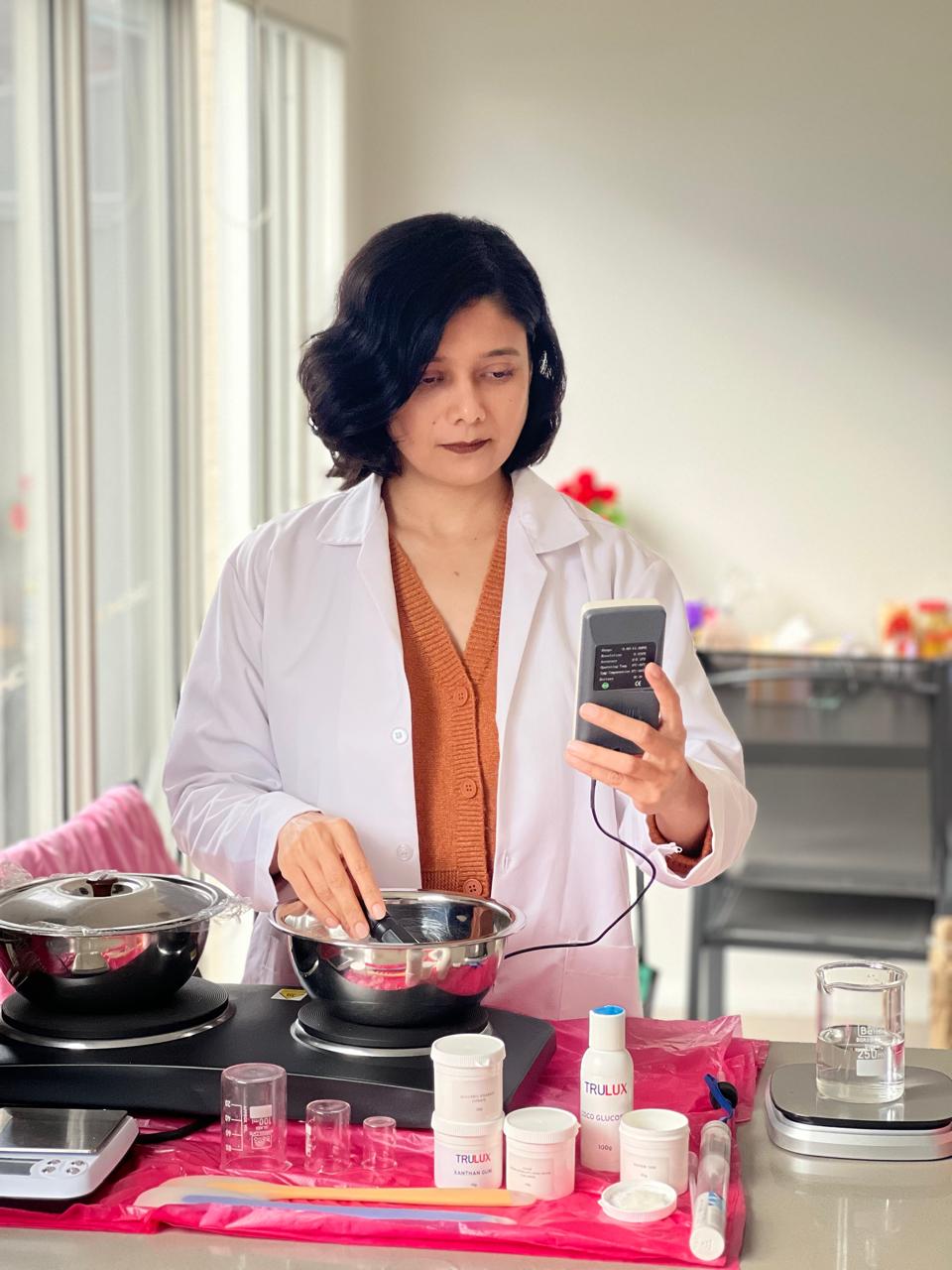
Dr. Vrushali Jagadale
Founder, Lead Consultant & Cosmetic Product Development Expert
Dr. Vrushali Jagadale is a cosmetic product development consultant, cosmetic chemist, and formulation specialist dedicated to helping entrepreneurs, startups, established brands, aesthetic clinics, and manufacturers transform innovative ideas into safe, effective, and commercially successful cosmetic products.
With a strong foundation in dentistry, cosmetic science, and advanced aesthetic medicine, she delivers end-to-end consulting across the complete product development lifecycle. From concept validation and ingredient selection to custom formulation, regulatory compliance, stability testing, manufacturer sourcing, production scale-up, and commercial launch, she provides expert guidance at every stage.
Dr. Vrushali has received advanced international training in cosmetic formulation and product development, including professional certification from the Institute of Personal Care Science (IPCS), Australia. Her expertise spans cosmetic chemistry, ingredient functionality, product safety, manufacturing processes, quality assurance, and global regulatory compliance.
She partners with beauty startups, skincare and haircare brands, private label companies, dermatologists, aesthetic professionals, and cosmetic manufacturers to develop innovative, high-performance products tailored to their business goals. Whether developing a new formulation, improving an existing product, resolving manufacturing challenges, or preparing products for domestic and international markets, every project is handled with scientific precision, regulatory confidence, and commercial focus.
From formulation strategy and clean beauty development to manufacturer coordination, documentation, technology transfer, and product launch support, Dr. Vrushali offers complete A-to-Z consulting solutions under one roof—helping clients build safe, compliant, scalable, and market-ready cosmetic brands with confidence.
Why Brands Choose Us
Science-First Approach
Every formula is built on rigorous cosmetic chemistry — not trends. Evidence-based ingredient selections backed by peer-reviewed efficacy data.
Fast Turnaround
Prototype formulas delivered in 2–4 weeks. Our established network of raw material suppliers and lab partners means no unnecessary delays.
Global Compliance Ready
Whether targeting India, EU, USA, or the Middle East — we formulate within the regulatory boundaries of every market from day one.
End-to-End Partnership
We stay with you through manufacturer liaison, stability testing, final QC, and your first production run — not just the formula.
Indie-Brand Friendly
We work with startups at low MOQs and help you find manufacturers who match your production stage and budget. No minimum requirement from us.
Clean Beauty Specialists
Extensive experience in natural, organic, vegan and Ayurvedic formulation. We know which "green" ingredients actually work — and which don't.
What Our Clients Achieve
Real results for real brands — from first-time founders to established cosmetic companies.
Successful Brand Launch
Take your product from concept to retail shelf with full formulation, regulatory, and manufacturer support.
Avg. 4–6 MonthsClean Label Products
Launch natural, vegan, or Ayurvedic ranges that meet EU & Cosmos Organic standards.
100% CertifiedPrivate Label Range
Build a private label portfolio under your brand — differentiated formulas, not generic off-the-shelf copies.
Custom MOQExport-Ready Formulas
Formulas compliant for Indian, EU, GCC, and US markets — ready for international retail and e-commerce.
Multi-MarketReformulation Projects
Update existing products to meet new regulations, improve stability, or reduce cost of goods without compromising performance.
Improved COGSManufacturer Tie-Up
Get introduced to our vetted network of GMP-certified manufacturers matched to your product category and scale.
Vetted NetworkRegulatory Dossier
Complete product information file, CPSR, safety data, and all documentation needed for market registration.
Submission ReadyFounder Education
We teach you the fundamentals of your own formulas so you speak confidently to manufacturers, investors, and customers.
Knowledge TransferReady to Master Cosmetic Formulation?
Join hundreds of satisfied founders and professionals who discovered the strategy, science, and supplier connections to bring their product vision to life — without the guesswork.
How Our Consultation Process Works
A clear, structured process designed to take you from idea to market-ready product — efficiently and without surprises.
Discovery Call
We understand your product vision, target consumer, regulatory market, and budget. A 30-minute deep-dive that maps out your full project scope.
Formula Strategy
We define the formulation brief — actives, texture, pH, preservation system, and claim substantiation. You receive a detailed strategy document.
Prototype & Testing
Lab prototypes are developed and submitted for stability, safety, and sensory testing. Iterative refinement until every benchmark is met.
Manufacturer & Launch
We connect you with the right manufacturer, manage technology transfer, and oversee your first production run through to shelf-ready product.
Start Your Formulation Journey
Whether you're a first-time founder or an established brand looking to expand your range — book a one-on-one consultation and get expert clarity on your next product.
Session Duration
30-Minute Expert Consultation | ₹2,000
What You Get
Formulation roadmap, regulatory checklist & manufacturer shortlist
Availability
Weekdays & Weekends — India, GCC, Europe & UK time zones
Post-Session Support
7-day WhatsApp follow-up included with every consultation
Ready to Get Started? Let's Talk.
🔒 Every consultation is handled under strict confidentiality. NDA available on request.
Tell Us About Your Project
Problems We Solve
From a stuck formula to a manufacturer who won't return your calls — these are the exact problems founders and brands bring to us every week.
Formula That Won't Work
Splitting emulsions, weak actives, poor texture, or a formula that simply doesn't perform the way you imagined. We diagnose the chemistry and fix it.
Sourcing Confusion
Not sure which raw material supplier is genuine, which INCI to trust, or where to source certified actives at the right grade and quantity.
Manufacturer Deadlock
Stuck at "MOQ too high," no response from contract manufacturers, or a factory that can't replicate your formula at scale.
Compliance Gaps
Missing CPSR, incomplete INCI labelling, or a product that isn't cleared for the market you want to sell in — India or abroad.
Scale-Up Failure
A formula that worked perfectly on the lab bench but breaks, separates, or changes texture the moment it's scaled to a production batch.
Budget & Timeline Overruns
Projects that drag on for months with no clear roadmap, or cost estimates that spiral once manufacturing begins.
Complete Product Development Process
Every product we develop moves through the same six disciplined stages — nothing skipped, nothing rushed.
Idea & Concept
We validate your product idea against market demand, target consumer, and positioning — before a single ingredient is chosen.
R&D & Ingredient Research
Deep-dive into active ingredients, benchmarking competitor products, and mapping out what will genuinely make your formula perform.
Formulation
Lab-scale prototype development — texture, pH, preservation system, and sensory profile refined through multiple iterations.
Testing & Validation
Stability, microbial, preservative efficacy, and compatibility testing to confirm the formula is safe and shelf-stable.
Manufacturing & Scale-Up
Technology transfer to a matched, GMP-certified manufacturer, with pilot batches checked before full production.
Launch
Regulatory sign-off, packaging brief, and go-to-market support so your product reaches the shelf ready to sell.
Formulation & R&D Services
Whether you're starting from a blank page or fixing an existing product, our formulation team covers the full technical scope.
Custom Formulation
Bespoke formulas built from scratch around your brief — skin type, target claims, texture, and price point.
Reformulation
Upgrade an existing product's performance, cost of goods, or compliance without losing what already works.
Active Ingredient Selection
Evidence-based selection of actives — retinoids, peptides, AHAs, niacinamide, botanical extracts — matched to your claims.
Stability & Shelf-Life Planning
Formulas engineered from day one for real-world stability, packaging compatibility, and an accurate shelf-life claim.
Preservation System Design
Preservative systems selected for efficacy and skin-safety, including preservative-free and natural-preservation approaches.
Texture & Sensory Development
Fine-tuning spreadability, absorption, fragrance, and finish so the product feels as good as it performs.
Claims Substantiation
Building the technical and clinical backing needed to support your marketing claims with confidence.
pH & Compatibility Optimisation
Fine-tuning formula pH and raw material compatibility to avoid irritation, instability, and packaging interactions.
Technical Documentation
Formulation briefs, manufacturing process sheets, and technical dossiers ready to hand to any manufacturer.
Product Categories We Work On
From a single hero serum to a full range launch, here's the breadth of cosmetic and personal care categories we formulate across.
Skincare
Facial Cleansers
Foaming, gel, cream & micellar water
Facial Toners
Hydrating, exfoliating & pH-balancing
Face Serums
Vitamin C, niacinamide, hyaluronic acid
Moisturizers & Creams
Day cream, night cream, gel cream
Face Masks
Sheet, clay, peel-off & overnight masks
Sunscreens
Lotion, gel-based & tinted SPF
Eye Care
Eye cream, under-eye gel & serum
Lip Care
Lip balm, lip scrub & lip oil
Anti-Aging Products
Retinol serum, peptide & firming creams
Acne & Blemish Care
Spot treatment, acne gel, salicylic wash
Facial Exfoliants
Scrubs, AHA/BHA peels, enzyme peels
Anti-Pigmentation & Brightening
Dark spot correctors & brightening serums
Dermo-Cosmetic / Clinical Skincare
Aesthetic-clinic and physician lines
Body Care
Body Lotions & Creams
Daily moisturizer & whipped body butter
Body Washes & Shower Gels
Foaming, moisturizing & exfoliating
Body Scrubs
Sugar, salt & coffee scrubs
Hand Creams & Sanitizers
Nourishing hand cream, alcohol-based sanitizer
Foot Care
Foot cream, callus remover, foot scrub
Deodorants & Antiperspirants
Roll-on, stick & spray formats
Body Oils
Massage oil, dry body oil, bath oil
Bath & Shower Products
Bath bombs, bubble bath & bath salts
Hair Care
Shampoos
Anti-dandruff, volumizing, colour-protect
Conditioners
Rinse-off, leave-in & deep conditioners
Hair Masks & Treatments
Protein masks & keratin treatments
Hair Oils & Serums
Growth oil & anti-frizz serum
Hair Styling Products
Gel, mousse, wax & hairspray
Hair Colour & Bleach
Permanent, semi-permanent & lightening
Scalp Care
Scalp scrub & anti-hair-fall tonic
Colour Cosmetics
Foundations & BB/CC Creams
Liquid, stick & cushion formats
Concealers & Colour Correctors
Under-eye, blemish & colour-correcting
Face Powders
Loose, compact & setting powder
Blushes & Bronzers
Powder, cream & liquid formats
Highlighters & Illuminators
Powder, liquid & stick highlighters
Eyeshadows & Palettes
Pressed powder & cream shadows
Eyeliners & Kohl
Pencil, gel & liquid liners
Mascaras
Volumizing, lengthening & waterproof
Eyebrow Products
Pencil, gel & pomade
Lipsticks & Lip Glosses
Matte, satin & glossy finishes
Lip Liners
Precision & long-wear formulas
Nail Polish & Nail Care
Lacquer, gel & nail treatments
Fragrance & Personal Care
Makeup Removers
Cleansing balms & micellar removers
Perfumes & Eau de Parfum
EDP, EDT & solid perfume
Deodorant Body Mists
Light fragrance sprays
Specialty & Clean Beauty
Men's Grooming
Shaving cream, aftershave & beard oil
Baby Care Products
Baby lotion, wash & diaper cream
Intimate Hygiene
Gentle intimate wash & wipes
Feminine Care
Intimate care & personal wipes
Ayurvedic & Herbal
Traditional formulations, modern standards
Organic & Natural Skincare
Certified organic, clean-label formulas
Vegan Cosmetics
100% plant-derived, cruelty-free
Regulatory & Compliance Support
A great formula means nothing if it can't legally reach the shelf. We handle compliance for India and every major international market.
India
- CDSCO cosmetic registration & licensing guidance
- BIS standards and labelling compliance
- Legal Metrology (packaging & declaration) compliance
- AYUSH guidance for Ayurvedic and herbal claims
- Import/export documentation for cosmetic products
International Markets
- EU Cosmetics Regulation & CPNP notification
- US FDA cosmetic labelling & MoCRA compliance
- GCC / Gulf Standards Organization requirements
- UK cosmetic product notification (SCPN)
- ASEAN, Australia (NICNAS) & other export markets
CPSR & Product Dossiers
Complete Cosmetic Product Safety Reports and information files prepared to submission standard.
INCI & Label Compliance
Accurate INCI listings, mandatory declarations, and claims language that stays within legal limits.
Market Clearance Support
End-to-end guidance through registration and notification so launch timelines don't stall on paperwork.
Manufacturer Sourcing
Finding the right factory is often harder than developing the formula. We manage sourcing end to end.
Private Label
Ready-made formulas you can brand as your own, with light customisation on fragrance, colour, or packaging.
Contract Manufacturing
Fully custom formulas manufactured to your exact specification, under your brand, from a matched GMP-certified partner.
MOQ Negotiation
We negotiate minimum order quantities that work for indie brands and early-stage founders, not just large orders.
Vetted Sourcing Network
Access to our screened network of manufacturers across India and internationally, matched to your category and scale.
Tech Transfer & Liaison
We manage the handover from lab formula to factory floor, including trial batches and process documentation.
Quality Control Oversight
Batch-to-batch QC checks so what ships from the factory matches what was approved in the lab.
Testing & Safety
Every formula is validated against the same rigorous testing standards before it goes anywhere near a production line.
Stability Testing
Accelerated and real-time stability studies to confirm the formula holds up under heat, light, and time.
Microbial Testing
Total viable count and pathogen screening to confirm the product is microbiologically safe for use.
Preservative Efficacy (Challenge) Testing
Challenge testing to confirm the preservation system actually protects the product over its shelf life.
Packaging Compatibility
Testing formula-to-packaging interaction so there's no leaching, discolouration, or degradation over time.
Safety & HRIPT Testing
Human Repeat Insult Patch Testing and dermatologist sign-off for irritation and sensitisation risk.
Claims Support Testing
Efficacy and sensory testing that gives you honest, defensible data to back your marketing claims.
Natural / Organic / Clean Beauty
Clean beauty done right takes as much science as any conventional formula. We build natural products that actually perform.
Natural Formulations
Plant-derived ingredient systems formulated for stability and performance without synthetic shortcuts.
Botanical & Herbal Products
Extract-led formulas using botanical actives, chosen for genuine efficacy rather than trend appeal.
Ayurvedic Formulation
Traditional Ayurvedic ingredient systems formulated to meet modern safety and stability standards.
Clean-Label Development
Ingredient decks built around clean-beauty exclusion lists, without compromising texture or shelf life.
Vegan & Cruelty-Free
100% plant-derived formulas with no animal-derived ingredients and no animal testing, end to end.
Certification Guidance
Support toward Cosmos Organic, Ecocert, vegan, and other clean-beauty certifications relevant to your market.
Cosmetic Product Development FAQs
Everything founders and brands typically ask before starting a formulation project — from cost and timelines to regulatory and manufacturing.
How do I start developing my own cosmetic product line?
Start with a discovery conversation about your product idea, target consumer, and budget. From there we map a formulation brief, define the actives and texture, and move into prototyping. You don't need a finished concept, just a clear sense of what problem your product should solve.
What does a cosmetic formulation consultant do?
A formulation consultant designs the actual chemistry of your product, guides ingredient selection, oversees stability and safety testing, and connects you with the right manufacturer. Think of it as the technical and strategic layer between your product idea and a factory production line.
How much does it cost to develop a cosmetic product?
Cost depends on formula complexity, number of actives, testing required, and target markets. A single-product project is priced very differently from a multi-SKU range launch. We give you a clear cost breakdown after the discovery call, once your scope is defined.
How long does it take to develop a skincare product from scratch?
Most single products take 4 to 6 months from brief to shelf-ready. Formulation and prototyping run 4 to 8 weeks, stability testing adds another 4 to 12 weeks, and manufacturing setup runs in parallel with final testing.
Can I develop a cosmetic product without any chemistry background?
Yes. Most of our clients come from marketing, medicine, retail, or general entrepreneurship, not cosmetic science. We explain every technical decision in plain language so you can make informed calls without needing a chemistry degree.
What is the minimum order quantity (MOQ) for cosmetic manufacturing in India?
MOQs usually start from 500 to 1,000 units depending on the product category and manufacturer. We work with a network that includes smaller-batch-friendly manufacturers, which matters a lot for first-time and indie brands.
How do I find a reliable cosmetic manufacturer in India?
Look for GMP certification, an existing product portfolio in your category, and transparency on MOQ and lead times. We shortlist vetted, GMP-certified manufacturers matched to your product type, batch size, and budget, and manage the relationship on your behalf.
What is the difference between formulation and manufacturing?
Formulation is the science of designing the product itself, its ingredients, texture, and stability. Manufacturing is producing it at scale in a factory. A formula has to be developed and tested before it can be handed to a manufacturer for production.
Do I need a license to sell cosmetics in India?
Yes, cosmetic products sold in India generally require CDSCO registration along with BIS and Legal Metrology labelling compliance. We handle this documentation as part of our regulatory support so your product is legally clear before launch.
What is CDSCO registration for cosmetics?
CDSCO (Central Drugs Standard Control Organisation) is India's regulatory body for cosmetics, and registration confirms your product meets national safety and labelling standards. It's a required step before manufacturing and selling most cosmetic products in the country.
How do I export cosmetic products from India to other countries?
Export requires your formula to meet the destination market's regulatory standards, whether that's the EU, US, GCC, or elsewhere, along with the correct documentation and labelling. We build formulas compliant for your target export markets from the start to avoid costly rework later.
What regulatory approvals are needed to sell cosmetics in the EU?
Selling in the EU requires compliance with the EU Cosmetics Regulation, a Cosmetic Product Safety Report (CPSR), and notification through the CPNP portal. We prepare the full technical file and guide you through each step of the submission.
Can you help me launch a private label skincare brand?
Yes. We can match you with private label formulas you brand as your own, or guide you toward custom formulation if you want a more differentiated product. Both paths include manufacturer sourcing and regulatory support.
What's the difference between private label and custom formulation?
Private label uses an existing, ready-made formula that you brand and lightly customise. Custom formulation builds a product from scratch around your specific brief, giving you a unique formula that competitors can't simply buy off the shelf.
How do I know if my cosmetic formula is stable enough to sell?
A formula needs to pass accelerated and, ideally, real-time stability testing that checks for separation, colour change, odour change, and texture shifts under heat, light, and time. Without this testing, you're guessing at shelf life rather than knowing it.
What is stability testing and why does my product need it?
Stability testing checks how a formula holds up over its intended shelf life under different storage conditions. It protects your customers from a product that degrades early, and protects your brand from returns, complaints, and regulatory issues.
What is preservative efficacy (challenge) testing?
Challenge testing deliberately exposes your formula to microorganisms to confirm the preservation system actually protects the product over time. It's a standard requirement before a water-based cosmetic product can be sold safely.
Do natural and organic cosmetics need different testing?
The testing requirements are the same, stability, microbial, and safety testing are still mandatory, but natural formulas often need extra care around preservation since many natural preservative systems are less robust than synthetic ones. We factor this into the formulation from day one.
Can an existing cosmetic formula be improved or reformulated?
Yes, this is a common project for us. We review your current formula for performance, stability, cost of goods, and regulatory compliance, then rebuild the parts that need improvement while keeping what already works for your customers.
What information do I need before approaching a formulation consultant?
A rough idea of your product category, target consumer, key claims you want to make, and your target markets is enough to start. You don't need finished specifications, ingredient lists, or a large budget locked in advance.
How do I create an Ayurvedic or herbal skincare brand?
We formulate Ayurvedic and herbal products using traditional ingredient systems built to meet modern stability and safety standards, and guide you through AYUSH compliance where relevant. This lets you keep the traditional positioning while meeting today's regulatory expectations.
Can you help with vegan and cruelty-free product development?
Yes. We build fully plant-derived formulas with no animal-derived ingredients and no animal testing, and can guide you toward vegan and cruelty-free certification if that's part of your brand positioning.
What packaging should I choose for my cosmetic product?
Packaging choice depends on your formula's chemistry as much as your branding, some actives degrade in clear packaging or react with certain plastics. We test formula-to-packaging compatibility before finalising so your product stays stable in the container you choose.
How do I protect my formula and business idea when working with a consultant?
Every client signs a mutual NDA before any project details are shared. Your formula, business plan, and intellectual property stay confidential throughout the engagement and after it ends.
What is a CPSR and why do cosmetic brands need one?
A Cosmetic Product Safety Report is a technical document that proves your product is safe for its intended use, covering ingredients, testing data, and toxicological assessment. It's required for regulatory submission in the EU and increasingly expected across other markets too.
Can small or first-time founders work with a formulation consultancy?
Yes, a large share of our clients are first-time founders. We work at low MOQs, explain the process in plain terms, and help you match with manufacturers who fit an early-stage budget rather than requiring large minimum orders from the start.
What cosmetic product categories are easiest to launch as a first product?
Single-purpose products like a face serum, lip balm, or body lotion tend to be simpler and faster to develop than multi-active formulas or colour cosmetics with complex pigment systems. They're a common starting point before expanding into a fuller range.
How do I scale up a formula from lab batch to full production?
Scale-up involves technology transfer to your manufacturer, running pilot batches, and adjusting for differences in mixing, heating, and batch size between the lab and the factory. We manage this process and re-test until the production batch matches the approved prototype.
What's included in a cosmetic product development consultation?
The first session covers your product vision, target consumer, regulatory market, and budget, and results in a formulation roadmap, a regulatory checklist, and a manufacturer shortlist. It's the foundation the whole project builds on.
How long does it take to develop a formula?
Typically 4–8 weeks from the formulation brief to an approved prototype, depending on complexity. Stability testing adds a further 4–12 weeks for accelerated or real-time studies.
Do you handle regulatory documentation?
Yes. We prepare complete product dossiers including CPSR, safety data sheets, INCI labelling, and assist with CDSCO registration and EU Cosmetics Portal notification.
Can you help with natural or Ayurvedic formulas?
Absolutely. We specialise in natural, vegan, Cosmos Organic certified, and Ayurvedic cosmetic formulation with certified organic and sustainable raw materials.
What if I already have a formula and just need a manufacturer?
We offer a "Formula Audit & Manufacturer Match" service — we review your formula for stability, regulatory compliance, and scalability, then connect you with the right production partner.
Cosmetic product development is the process of turning a product idea into a commercially viable, stable and market-ready cosmetic product. It involves much more than creating a formula. A successful product requires the right concept, ingredients, formulation strategy, testing, packaging considerations, manufacturing process and market direction.
Whether you are launching a new skincare brand, developing a professional cosmetic product, expanding an existing beauty business or improving an existing formulation, working with an experienced cosmetic product development consultant can help bring the technical and commercial aspects of the project together.
Cosmetic Product Development: From Product Idea to Market-Ready Product
Quick answer: Cosmetic product development is the full path from a product idea to a finished, sellable product. It covers the brief, formulation, prototypes, testing, packaging, manufacturing, scale-up and market preparation, and every stage affects the next one.
Most beauty brands start with a single sentence. "I want a vitamin C serum that doesn't feel sticky." "We need a shampoo that works with hard water." "Our clinic wants its own aftercare cream."
That sentence is a great starting point. It is also nowhere near a product.
Between the idea and a bottle on a shelf there are dozens of decisions: which ingredients, what texture, which preservative, what pH, which container, how big a batch, what you can say on the label. Get them right and the launch feels calm. Get them wrong and you find out the expensive way, usually after the packaging has been printed.
Cosmetic product development is the structured process that connects the two ends. Depending on the project, it can include concept development, ingredient research, formulation, prototype work, testing, stability evaluation, packaging compatibility, manufacturing support, scale-up and market preparation.
The stages depend on each other more than people expect. A vague brief gives you a confused formula. A formula that was never tried in its real pump gives you a returned batch. A batch made without a written process gives you a product that behaves differently every time you make it.
That is where a professional cosmetic product development consultant earns their place. Instead of treating the formula as a separate lab exercise, the whole product is treated as one system. The formula, packaging, manufacturing method, customer and market all need to agree with each other.
At Aesthetic Training India, development is built around the product's purpose, the target customer, the formulation requirements, the manufacturing needs and the market goals. The point is to make the technical side clear enough that you can decide with confidence, not just nod along.
This guide walks through the whole journey in plain language: what development involves, how ingredients and prototypes are chosen, what testing and regulatory planning look like, how private label differs from custom work, and which mistakes to avoid. If you are a first-time founder, a clinic owner, a formulator or an established brand, you should finish it with a clearer picture of how a cosmetic idea becomes a finished product.
What Is Cosmetic Product Development?
Quick answer: Cosmetic product development means creating, improving or commercialising a cosmetic or personal care product. It runs from the first concept through formulation, testing and manufacturing to launch, and it also covers fixing or updating products that already exist.
It can start with a blank page. It can just as easily start with a product that already sells but needs to be fixed, modernised, reformulated or adapted for a new country.
The word "development" is doing real work here. A cosmetic is not mixed once and declared finished. It is designed, tested, adjusted, tested again and written down until it meets a clear set of requirements. Those requirements pull in different directions at the same time: what the customer wants to feel, what the ingredients can safely and stably deliver, what the factory equipment can reproduce, what the packaging allows and what the target market permits.
No two products follow the same road. A facial cleanser needs a different strategy from a serum, a cream, a shampoo, a hair mask or a professional clinic product. A water-based gel raises different questions from an oil-in-water emulsion. A rinse-off product behaves differently from something left on the skin all day.
So the first conversation should be about the product, not the ingredient list. Plenty of projects go sideways because the opening question was "can we add this trending active?" instead of "who is this for and how should it feel?"
Product Development vs Formulation: What's the Difference?
People mix these two up all the time, so here is the simple version. Cosmetic formulation is the technical act of choosing ingredients and building a stable, pleasant, functional formula. Product development is the bigger project wrapped around it: the brief that comes first, and the testing, packaging, manufacturing and market work that come after.
You can buy a formula and still be far from a launchable product. The formula might not survive in your chosen pump. It might separate in a warm warehouse. A contract manufacturer might struggle to reproduce it. It might contain something you cannot market in your target country. Development is the discipline that catches those problems while they are still cheap to fix.
Who Needs Cosmetic Product Development?
The list is wider than most people guess.
- First-time founders with a clear brand vision and a strong sense of their customer, but no cosmetic science background.
- Dermatologists, aesthetic clinics and salons that want a signature range for treatments, aftercare or retail.
- Existing brands that want a new category or a refresh of an ageing bestseller.
- Manufacturers who want a stronger formulation portfolio.
- Exporters who need products adapted for different regulatory environments.
- Entrepreneurs who tried private label and found it did not give them enough differentiation.
What they share is the need for a route from idea to product that is organised, technically sound and commercially realistic.
The Role of a Cosmetic Product Development Consultant
Quick answer: A cosmetic product development consultant connects the technical stages of making a cosmetic: concept, formulation strategy, ingredient selection, prototype review, testing plans, troubleshooting, manufacturer coordination and scale-up. The goal is a practical route to the product you actually want.
This kind of support matters most for founders and brands with no in-house formulation or product-development team. Large beauty companies have whole departments for research, quality, regulatory and packaging. A small brand rarely has that, and usually does not need it full time. It needs experienced guidance at the right moments.
The consultant's job is not just to hand over a formula. It is to work out what the product needs to achieve and then find a workable way to get there. Sometimes that means building a formula from scratch. Sometimes it means reviewing a formula a manufacturer supplied and explaining what it does and does not do. And sometimes it means telling a founder honestly that the product they pictured cannot be made at the price they hoped, then suggesting the closest version that can.
What a Good Consultant Actually Does
In practice the work happens on several layers at once.
- Turns business ideas into technical requirements. "A luxurious, fast-absorbing night cream" becomes a defined emulsion type, emollient profile, texture range and target viscosity.
- Chooses and justifies ingredients. Every raw material has a job.
- Plans the lab work. Prototypes move in a deliberate direction instead of wandering.
- Advises on testing. The right questions get asked before launch, not after the first complaint.
- Speaks to manufacturers in technical language. That protects the brand from misunderstandings.
Just as important, a good consultant is honest about trade-offs. Every formula balances cost, performance, feel, stability and claims. Explaining those trade-offs plainly is part of the service, because it lets you make decisions with your eyes open.
When to Bring in a Consultant
Early is best. Ideally before ingredients are chosen, before packaging is ordered and before a manufacturer is locked in. At that stage a little technical guidance can shape the whole project.
Plenty of people call later, when a product has stability problems, when a manufacturer's sample does not match what they hoped for, or when a launch has been held up. Help at that point still works. It is just usually more expensive than avoiding the problem in the first place.
Cosmetic Formulation Consultant for New and Existing Products
Quick answer: A cosmetic formulation consultant works on the technical side of the formula: ingredient selection, structure, texture, pH, viscosity, preservation, compatibility and prototype refinement. They can build a new formula or reformulate, troubleshoot and improve an existing one.
Where the development consultant watches the whole project, the formulation consultant works at the bench and on the formula itself. In many engagements one person covers both roles.
For a new product, formulation starts with the desired characteristics. How should it feel on first touch? What should it leave behind after a minute? What container will it live in? What price band does it need to fit? The answers become the design criteria.
For an existing product the starting point is different. The product already has customers, so the job is usually to change one thing without upsetting everything else. That takes careful, controlled work.
If your need is mainly about the formula itself, take a look at our cosmetic product formulation services to see how the technical formulation stage is handled.
Why Formulation Experience Matters
Cosmetic science borrows from chemistry, physics, dermatology, microbiology and sensory science. The reason experience counts is that these fields interact in ways an ingredient list does not show.
A thickener that works beautifully at one pH can collapse at another. An emulsifier that suits one oil phase can struggle with a different one. A preservative that performs well in one base can be partly switched off by another ingredient in the same jar.
A formulator who has seen these things before can design around them. It does not remove the need for lab work, but it cuts down wasted trials and shortens the road to a stable, pleasant product.
Understanding the Product Idea Before Formulation
Quick answer: Before any lab work, write a product brief covering the target customer, intended use, format, sensory experience, positioning, price range and target market. A clear brief keeps cosmetic product development focused and saves weeks of guesswork.
One of the most important stages of cosmetic product development happens before anyone picks up a beaker. It happens on paper and in conversation, and it ends in a brief.
Each item in the brief narrows the range of sensible formulas. Together they turn an open request into a design problem with clear edges.
Without a brief, formulation can drift into rounds of small changes with no finish line. The founder keeps saying "not quite", the formulator keeps guessing what "quite" means, and weeks go by with nothing solid to show.
Understanding the Target Consumer
The customer shapes many formulation decisions. A lightweight serum for a humid climate needs a different feel from a rich cream for dry skin. Someone rushing out the door will judge a product differently from someone doing a slow evening routine.
A professional-use product can have different needs from a daily consumer product. Therapists in a clinic room may care about glide, workability and how the product performs during a treatment. Someone using a product at home usually wants it to be forgiving, pleasant and easy to understand.
Age group, skin or hair type, climate, cultural habits, budget and attitudes to ingredients all belong in the brief. So does the emotional side. Some customers want a clinical, scientific feel. Others want a spa-like sensory experience. Others just want something simple that works and does not cost a fortune.
Choosing the Product Format
The same active can be delivered as a gel, serum, lotion, cream, oil, balm, mask, spray or stick. Each format changes the feel, the packaging, the preservation needs and the manufacturing. So choosing a format is a technical decision as well as a marketing one.
- Water-based gel: light and fresh, but offers little occlusion.
- Oil-in-water emulsion: versatile and familiar to most customers.
- Water-in-oil emulsion: rich and protective, but harder to stabilise.
- Anhydrous balm or oil: avoids most preservation questions, but has its own texture and stability challenges.
Thinking this through early avoids the classic trap: falling in love with a concept that the chosen format simply cannot deliver.
Positioning, Price and Differentiation
Positioning describes where the product sits in the market: mass, masstige, premium or professional; clinical or sensorial; minimalist or luxurious; natural or performance-driven. It matters because positioning sets expectations for ingredients, texture, fragrance, packaging and price, and the formula has to live up to them.
Differentiation is the reason a customer picks your product over the dozens of similar ones. It might be a texture, an unusual combination of ingredients, a specific skin concern, a professional origin or a strong brand story. A formula does not have to be exotic to stand out. But the brief should say clearly what makes it different, because development has to protect that difference.
Ingredient Selection for Cosmetic Products
Quick answer: In cosmetic formulation, every ingredient should be chosen for a clear function, compatibility with the rest of the formula, availability and suitability for the final product. A longer ingredient list does not mean a better product.
Ingredient choice is at the heart of cosmetic formulation. Each raw material comes with a cost, handling requirements, a regulatory status and a possible effect on everything else in the jar.
A long ingredient list can look impressive on a label. But every extra ingredient adds cost, adds a possible interaction and makes the formula harder to stabilise, manufacture and explain. The goal is not the most actives. The goal is that every ingredient has a reason to be there.
Depending on the product, a formula might use humectants, emollients, occlusives, surfactants, emulsifiers, preservatives, antioxidants, botanical extracts, functional actives, polymers, conditioning agents, fragrances or pigments. Knowing what each group does is the first step to understanding why a formula behaves the way it does.
The Main Groups of Cosmetic Ingredients
Humectants such as glycerin, propanediol, sodium PCA or hyaluronic acid attract and hold water in the upper layers of skin. Emollients are the oils, esters and butters that soften the skin and shape how a product feels, from dry and silky to rich and cushioned. Occlusives such as petrolatum or certain waxes form a barrier that slows water loss. Together these three groups are the backbone of most moisturisers.
Surfactants do the cleansing and foaming in cleansers, shampoos and body washes. They range from harsh to very mild, and the blend you choose decides how the product foams, how it rinses and how the skin feels afterwards. Emulsifiers let oil and water live together in creams and lotions, and they largely decide the texture and stability of the emulsion.
Thickeners and polymers control viscosity and hold ingredients in suspension. Preservatives protect water-containing products from microbial growth. Antioxidants protect delicate oils and actives from going off. Chelating agents support stability by binding trace metals. Fragrance and colour shape the sensory identity, and both come with their own compatibility and regulatory questions.
Choosing Functional Actives
Actives are the ingredients picked for a specific cosmetic purpose: hydration, conditioning, brightening support, antioxidant protection, exfoliation, soothing. Picking them well means asking a few plain questions.
- Is it permitted in the target market, and at what level?
- Will it stay stable in the chosen base and packaging?
- Does it get along with the other ingredients?
- Does the concentration make sense technically and commercially?
- Can the marketing claim about it be properly supported?
Some actives are demanding. Certain forms of vitamin C oxidise fast. Some acids need a low pH to work, which limits what else can share the formula. Retinoid-type ingredients dislike light and air. Botanical extracts can vary from one batch to the next and may shift colour and smell. None of that is a reason to avoid an ingredient. It is a reason to plan the formula and the packaging together.
Raw Material Quality, Sourcing and Paperwork
The same ingredient name can hide very different quality levels. Purity, grade, origin and the supplier's own quality system all vary, and they matter more than beginners expect. Reliable suppliers provide technical data sheets, safety data sheets, certificates of analysis and regulatory declarations. That paperwork is not clutter. It is part of showing that your product was made responsibly.
Think about supply security too. A formula built around a rare, single-source ingredient is exposed if that material disappears or doubles in price. Where possible, development should ask whether alternatives exist and whether the formula could accept them.
Formulation Development and Prototype Creation
Quick answer: Prototypes are small lab batches used to test a formula against the brief. The first version is rarely the final one. Several rounds of controlled adjustment to texture, stability, appearance, fragrance, viscosity and pH are a normal part of professional cosmetic product development.
Once the brief and ingredient strategy are set, the lab work begins. This is what most people picture: small batches, beakers, scales, mixers and a lot of careful notes.
The first prototype is not supposed to be the answer. It might be close in texture but too greasy. It might feel lovely and then separate when warmed. Each trial exists to teach you something specific, so each round should be planned around a question.
Founders who expect a perfect formula from one attempt often panic when version two or three appears. Don't. Several rounds are normal, especially for complex emulsions, demanding actives or products with a tough sensory target.
How Lab Prototypes Are Managed
Good lab habits matter even at small scale. Every trial should record what went in, how much, in what order, at what temperature, at what mixing speed and for how long, plus what was observed at each step. That record lets the formulator repeat what worked and understand what did not. It also becomes the base for the manufacturing process later.
Change one variable at a time. If three things change together and the result improves, nobody knows which one helped. Disciplined iteration feels slower per step, but it is much faster overall because it builds understanding instead of luck.
Emulsions, Gels, Cleansing Systems and Anhydrous Products
The main structures each have their own themes.
- Emulsions (most creams and lotions) depend on the balance of oil phase, water phase and emulsifier. Getting the emulsifier type, level and process right decides droplet size, stability and feel.
- Gels rely on polymers or gelling agents that are sensitive to pH and salts. Clarity, spreadability and stickiness are the usual worries.
- Surfactant-based products (cleansers, shampoos) balance cleansing power, foam, mildness and thickness, and the thickening often depends on delicate surfactant and salt interactions.
- Anhydrous products (balms, oils, sticks) skip water but need care with melting points, crystallisation and oxidation.
A formulator who works across these structures builds an instinct for which approach fits which brief. That instinct is a big part of what shortens development time.
Texture, Appearance and Sensory Experience
Quick answer: Customers judge a cosmetic within seconds by how it feels, looks and smells: spread, absorption, slip, after-feel, colour and fragrance. Sensory design should happen during formulation, not after the formula is locked.
Very few customers read the ingredient list closely. Every one of them notices within seconds whether a product feels right. The way a cream spreads, the after-feel of a serum, the foam of a cleanser or the finish of a hair product shapes the entire experience.
So sensory thinking belongs inside the formulation stage. Pick-up, spread, absorption, slip, tackiness, richness, cooling or warming sensation, residue and after-feel all count. So do colour, opacity, shine, fragrance and even the sound of the pump.
Fragrance and Colour
Fragrance is one of the most emotional parts of a product and one of the trickiest technically. It has to suit the base, stay stable over time, be appropriate for the market and, in many places, respect limits on specific fragrance allergens. Fragrance-free products are a challenge of their own, because the raw materials often smell of something and that has to be managed.
Colour matters as well. Pigments, dyes and even the natural colour of botanical extracts can shift with time or light. The shade and clarity a brand wants on day one still have to be there in month twelve, whether the product sits in a warehouse, a bathroom or a handbag.
Real-User Feedback
Once a prototype is stable, feedback from real users is very useful. Small, well-organised rounds can show whether the texture matches expectations, whether the fragrance works and whether the product fits the routine the brand imagined. This is not the same as formal performance testing, but it helps refine the formula before bigger money is committed.
Testing in Cosmetic Product Development
Quick answer: Testing checks that a product stays stable, resists contamination, suits its packaging, is appropriate for its users and does what the brand says it does. The exact programme depends on the product, formula, packaging and target market.
Testing is a core part of responsible cosmetic product development. There is no single checklist that fits every product, which is why planning the testing strategy is itself part of the work.
Depending on the project, this can include stability evaluation, microbiological testing, preservation evaluation, packaging compatibility and other suitable safety or performance assessments. Some are done in the development lab. Others are run by accredited third-party laboratories. Some involve human volunteers under proper ethical and professional oversight.
A helpful way to think about it: testing is a set of questions.
- Will the product stay the same for its whole shelf life?
- Is it protected from microbes during manufacture and everyday use?
- Does it react with its container?
- Is it appropriate for the people who will use it?
- Does it deliver what the label promises?
Each question points to different tests.
Stability Evaluation
A cosmetic has to keep acceptable characteristics for its intended storage period. Temperature, light and time can change appearance, colour, fragrance, viscosity and physical stability. A cream that looks perfect on the day it is made can separate after three months in a warm distribution chain if the formula was never designed to cope.
That is why stability belongs in development, not after the formula is finalised. Typical programmes store samples at room temperature, elevated temperature, in the fridge, through freeze-thaw cycles and under light, and track appearance, colour, odour, pH and viscosity over time. Samples are also kept in the real final packaging, because a formula can behave differently in glass than in plastic.
Accelerated conditions give early signals, but only signals. Real-time data remains the reference for confirming shelf life, so plan your launch calendar around it.
Preservation and Microbiological Safety
Water, nutrients and skin contact make many formulas a comfortable home for bacteria, yeasts and moulds. Contamination can spoil the product and, worse, harm the user. So any water-containing product needs a properly thought-out preservation system.
Preservation is not a separate decision. It has to work together with the formula composition, pH, packaging, manufacturing and intended use. Some preservatives only work within a certain pH window. Some are partly neutralised by other ingredients. Some raise questions with customers who read labels. And a jar that people dip their fingers into faces a tougher job than an airless pump that stays sealed.
A preservative efficacy test, often called a challenge test, checks whether a formula can withstand deliberate contamination. Microbial limit testing checks finished product for unacceptable levels of organisms. Clean production matters just as much, because no preservative can make up for a dirty factory.
Safety and Performance Assessment
Safety comes first. Depending on the market, a cosmetic may need a formal safety assessment by a qualified professional, based on the ingredients, their levels, the exposure and the intended users. In some regions that is a legal requirement before sale. Extra studies such as patch tests or other dermatological evaluations may make sense depending on the product, the claims and the sensitivity of the area of use.
Performance testing is separate. If a product claims to hydrate, smooth or brighten the look of skin, that claim should be supported at a level that fits the wording. Instrumental measurements, consumer perception studies and expert grading each have a role, depending on what is being said.
Packaging Compatibility
Quick answer: A formula can behave differently in a jar, tube, pump, dropper, bottle or airless system. Packaging affects stability, preservation, dispensing and user experience, so it should be tested with the formula during development, not chosen afterwards.
Packaging is not a neutral wrapper. It is part of the product.
Some plastics absorb fragrance or oils. Some formulas soften or discolour certain materials. Light-sensitive ingredients need opaque or UV-protective containers. Oxygen-sensitive actives may need airless systems. Viscosity decides whether a pump can dispense properly, and a lovely serum turns into a frustrating one if the dropper cannot give a consistent dose.
Packaging and Sustainability
Customers increasingly ask about recyclability, refills and materials, and many brands want to reflect those values. Sustainable choices are worth pursuing, but they get tested like everything else. A recycled or bio-based material may behave differently from a conventional one, and a refill system can introduce new preservation and hygiene questions. Explore these options during development, not once the formula is fixed.
Labels and Artwork
Packaging also carries required information as well as branding. Depending on the market, labels may need an ingredient list in a prescribed naming system, batch codes, business details, directions, warnings and storage information. Leaving this to the end causes delays, because the label has to match the final formula and the local rules. Running artwork alongside development avoids a last-minute scramble.
Regulatory Considerations in Cosmetic Product Development
Quick answer: Regulatory requirements depend on the country, product category, ingredients, claims, packaging and how the product is sold. Plan them alongside formulation from day one, because a restricted ingredient or a wrong claim found late can force a reformulation.
A product that is perfectly fine in one country may need changes before it can be sold in another.
Choosing a restricted or prohibited ingredient is far cheaper to discover on day one than in month six. Treating regulation as a last step, separate from formulation, is one of the most common and costly habits in the industry.
Handled together, development, documentation and market positioning move in the same direction.
Product Development for Indian and International Markets
In India, cosmetics are regulated under national drug and cosmetic legislation, with requirements covering registration, labelling, permitted ingredients and product standards. Other regions, including the European Union, the United Kingdom, the United States, the Gulf and Southeast Asia, each have their own frameworks, with differences in notification, safety documentation, ingredient restrictions, label language and claims rules.
Those differences can affect formulation, claims, documentation, labelling, testing and packaging. A preservative accepted in one market may be restricted in another. A claim that passes in one region can be treated as a medicinal claim elsewhere.
If you plan to sell abroad, thinking about the target markets early can save you avoidable changes later. Rules also change over time, so always confirm the current requirements for your product category and market with the relevant authority or a qualified regulatory professional before launch.
Good Manufacturing Practice and Quality Systems
Beyond the formula, regulators and retailers often expect products to be made under a recognised quality system. Good manufacturing practice for cosmetics covers staff hygiene, premises, equipment, raw material control, batch records, quality control, storage and complaint handling. When you work with a contract manufacturer, one practical question is whether they follow a suitable standard and can supply the documents you will need.
Documentation and Record Keeping
Behind every cosmetic sits a file: formula records, ingredient specifications, safety information, stability and preservation data, manufacturing instructions, batch records, packaging specifications and claim support. Building it as you go is far easier than reconstructing it later, and it becomes valuable the moment a retailer, distributor, authority or customer asks a question.
Claims and Cosmetic Product Positioning
Quick answer: Cosmetic claims should match a cosmetic function and be supported to the standard of the target market. Language that implies treating or preventing disease usually moves a product out of the cosmetic category.
A cosmetic generally cleanses, perfumes, protects, changes appearance, keeps the body in good condition or corrects body odour. Claims that suggest treating or preventing a disease usually push a product into a different regulatory space.
During development, it helps to separate the marketing idea from what the finished product can appropriately support. "Hydrates the skin" and "reduces the look of dryness" are very different from wording that implies medical results. A good process tests the brand's ambitions against reality and shapes claims that are attractive, honest and defensible.
Avoid Over-Promising
Over-promising is one of the quickest ways to hurt a young brand. A product that gives a pleasant, reliable experience with a modest, truthful claim builds trust. A product that promises a dramatic transformation and delivers ordinary results creates disappointment, poor reviews and sometimes regulatory trouble. Matching what the formula can do with what the marketing says is a discipline, and part of responsible development.
"Free From", "Clean" and Similar Claims
Wording like "free from" certain ingredients, "clean", "dermatologically tested" or "suitable for sensitive skin" is popular and easy to misuse. Each phrase needs a definition, evidence and compliance with local rules. Decide what you actually mean by these terms, and what stands behind them, before the words go on a pack.
Cosmetic Product Development for New Beauty Brands
Quick answer: New brands usually have a strong idea and limited technical resources. Cosmetic product development consultancy gives them a structured path from concept to formula to manufacturing, ideally starting with one focused hero product.
A founder often knows their customer and their brand story inside out, but has no idea how to get from "this is exactly what I want" to "this is exactly how it is made". That gap is where promising brands stall, or where they rush into decisions they regret later.
Professional cosmetic product development consultancy gives that journey a structure. For a new brand it often means help writing the brief, choosing a realistic first product, setting sensible budgets, picking suppliers and manufacturers, and understanding what each stage involves before money is committed.
Starting with one focused hero product is often smart. A single well-developed serum or cream teaches a young company a huge amount: how the market reacts, how the supply chain behaves, how a production run actually feels, and what customers say after using it. That knowledge makes every later product easier.
Mistakes New Brands Make Again and Again
- Choosing packaging before the formula exists, then finding the formula does not suit it.
- Ordering big minimum quantities before the product has been properly tested.
- Copying a competitor's ingredient list. The same ingredients at different levels and with a different process make a very different product.
- Launching five products at once and giving none of them enough attention.
- Treating safety and regulatory work as a formality to sort out once the product looks finished.
None of these is unusual, and all are avoidable with a clear plan and someone who will challenge assumptions early.
Realistic Time and Budget Expectations
Cosmetic development takes longer than most first-time founders expect. Prototype refinement, stability observation, sample approvals, packaging lead times and manufacturing schedules all take real calendar time, and some of it cannot be rushed. A sensible plan leaves room for iteration and for surprises. Launching a few weeks later with a stable, repeatable product is far better than launching on time with something you have to rework or recall.
Cosmetic Product Development for Established Brands
Established brands come to development for different reasons. They may want a new category, an improved formula, a raw material change, fewer manufacturing headaches or products for a new market.
The pressures are different too: existing customers with expectations, existing suppliers and equipment, and a portfolio that has to stay coherent. A loyal customer who loves a certain texture will notice when it changes. A retailer who approved a formula may need to be told about a modification. Even a small tweak can ripple through documentation, stability data and labels.
So development for an established brand has to respect the product's history and customer expectations while looking for real improvements. A fresh technical view also helps. Internal teams get used to their own habits and limits, and an outside perspective can point to simpler or cheaper routes nobody had tried.
Reformulation and Product Improvement
Quick answer: Reformulation means changing an existing formula because of ingredient availability, regulation, cost, stability, manufacturing or customer feedback. It should be done in a controlled way, because changing one ingredient can change how the whole formula behaves.
Not every project starts from zero. Sometimes an ingredient is discontinued. Sometimes a rule restricts a material. Sometimes customers just want something lighter, less sticky or more modern.
Careful is the key word. Swap an emollient and viscosity can shift. Replace a preservative and the pH window for stability can change. Substitute a thickener and clarity and texture can move. A responsible reformulation compares the new version against the old across a defined list of properties, instead of judging by eye.
An experienced cosmetic formulation consultant can assess the current formula and build a structured plan for improving it. That usually starts by understanding what the product does well, what needs to change and what must not change, and then making the modifications in a controlled, documented way.
Common Reasons to Reformulate
Typical drivers are removing a specific ingredient for marketing or regulatory reasons, reducing cost, switching suppliers, moving to more sustainable or naturally derived materials, improving texture or stability, and adapting a product to a new market with different rules. Each driver sets slightly different priorities, so being clear about which one applies keeps the project focused.
Troubleshooting Cosmetic Formulations
Quick answer: Troubleshooting finds the root cause of a formulation problem, such as separation, viscosity change, colour shift, odour, poor texture or failed scale-up, by looking at the formula, process, raw materials, packaging and storage together.
Problems can show up in the lab, in pilot batches, in commercial production, or months after launch when a batch behaves oddly or a customer complaint exposes something early testing missed.
Common ones include separation, changes in viscosity, colour changes, unwanted odour, poor texture, instability and difficulty reproducing a lab prototype at larger scale. Others are crystallisation, graininess, pilling on skin, foam that is too weak or too heavy, discolouration inside the container and microbial growth.
The right first move is to find the cause, not to start swapping ingredients at random. Look at formula, process, raw materials, packaging and storage together. Did a supplier or ingredient batch change? Was the order of addition different? Was the product heated or cooled at a different rate? Was storage hotter than expected? A methodical investigation usually beats trial and error.
Root-Cause Thinking
Take a separated emulsion. The cause might be an emulsifier level that is too low, an incompatible ingredient, mixing that did not create small enough droplets, a pH shift that upset the emulsifier, or a thickener that lost its effect. Each cause has a different fix. Treating the symptom without knowing the cause can make things worse, or hide a problem that returns later in a new form.
Scale-Up From Laboratory to Manufacturing
Quick answer: Scale-up support turns a lab formula into a repeatable factory process. Batch size, mixing equipment, heating and cooling rates and processing time can all change how the finished product turns out.
A cream that is smooth and glossy from a small lab mixer can come out thin or grainy from a large production vessel if the shear, temperature profile or addition times differ.
Scale-up support bridges that gap. It translates a lab method into a manufacturing process, looking at equipment capability, heating and cooling rates, mixing intensity, addition sequence, hold times, filling conditions and in-process checks.
The aim is a practical process that reproduces the approved product every time. Consistency is the true test of a formulation. A formula that works once is a prototype. A formula that works in every batch is a product.
Pilot Batches and Process Approval
Before full-scale production, many brands make pilot batches under near-real conditions. Pilots reveal foaming during filling, viscosity drift while cooling, ingredient addition problems and differences in appearance. They also produce material for final stability testing in the actual packaging. Approving the process only after a successful pilot sharply reduces the chance of an expensive failed commercial batch.
Manufacturer Sourcing and Development Support
Quick answer: The right manufacturer depends on your product category, production scale, equipment, quality standards, minimum order quantities and technical needs. A cosmetic product development consultant can assess options from a product and technical point of view.
Not every factory does every product well. One that is excellent at shampoo may lack the equipment for high-quality emulsions or products with tighter hygiene needs.
The right questions help. What products do they normally make? What quality standards and certificates do they hold? How are batches documented and released? What are the minimum orders? How do they handle formula ownership and confidentiality? What happens if a batch fails?
Who Owns the Formula?
This one deserves its own line. Some manufacturers sell their own ready formulas, which stay their property. Others produce brand-owned formulas developed independently. Confidentiality, exclusivity and intellectual property terms should be clear before development starts, because they decide whether you can move production elsewhere later. Take legal advice on this point.
Working Well With a Contract Manufacturer
Good relationships with contract manufacturers run on clarity: clear specifications, agreed approval steps, written process instructions, defined quality criteria and honest communication. It helps enormously to have someone on your side who speaks both the brand's language and the factory's.
Private Label vs Custom Cosmetic Product Development
Quick answer: Private label means using a manufacturer's existing formula with your branding. Custom cosmetic product development means building a formula around your own requirements. Private label is faster and cheaper to start. Custom gives more control and differentiation.
Choosing between them is one of the first strategic decisions a new brand makes. Here is a side-by-side view.
| Factor | Private Label | Semi-Custom | Fully Custom |
|---|---|---|---|
| Starting point | Existing manufacturer formula | Existing base, modified | Your own brief |
| Speed to market | Fastest | Moderate | Longest |
| Upfront investment | Lowest | Moderate | Highest |
| Differentiation | Limited | Meaningful | Highest |
| Control over ingredients and texture | Low | Medium | High |
| Formula ownership | Usually manufacturer | Depends on agreement | Usually brand, if agreed |
| Best for | Testing a market quickly | A balance of cost and uniqueness | Brands built on a distinctive product |
Private label is typically quicker and lighter on investment because the formula already exists and has usually been made before. The trade-off is limited differentiation. Other brands may be selling the same or a very similar product under a different name.
Custom development begins with your requirements and builds the formula around them. It offers more control over ingredients, texture, positioning and claims, and it can produce something genuinely distinctive. The trade-off is more time, more money and more decisions.
Semi-custom sits in the middle: start from an existing base and modify it, for example the active complex, fragrance, texture modifiers or colour. It can give real differentiation at lower cost and shorter timelines than fully custom work, though the base remains a starting point, not a blank slate.
Which one is right depends on your budget, timeline, differentiation strategy and how much customisation you want. Some brands begin with private label to test the market and move to custom once they know their customers. Others invest in a custom hero product from day one because uniqueness is the whole point. Neither is wrong. Just choose knowingly.
Natural and Organic Cosmetic Product Development
Quick answer: Natural and organic products still need serious formulation science. Plant-based ingredients bring their own stability, preservation, compatibility and sensory challenges, and any certification standard should be chosen at the start.
"Natural" does not automatically mean simple, stable or gentle. Natural oils oxidise. Botanical extracts vary between harvests. Many natural thickeners and emulsifiers behave differently from their synthetic counterparts.
Brands going natural or organic should decide early which standard or certification they want to meet. Different bodies define natural and organic differently, with their own lists of allowed and banned ingredients and their own rules about processing. Choosing early, or deciding not to follow a certification at all, prevents painful reformulation later.
Clean, Vegan and Cruelty-Free Positioning
These terms matter to many customers, but none has one universal definition. Vegan formulation avoids animal-derived ingredients, which means checking the source of materials such as some emollients, waxes, proteins and colours. Cruelty-free relates to animal-testing policies for finished products and ingredients, and may involve verification or certification. "Clean" is more a marketing idea than a technical one, and every brand defines it differently. The safest route is to state exactly what each word means for your brand and make sure the formula, supply chain and paperwork really back it up.
Sustainability in Development
Sustainability can enter at several points: responsibly sourced ingredients, concentrated or anhydrous formats that reduce water content, biodegradable materials where appropriate, lighter packaging and refill design. These are meaningful choices, but they interact with performance and stability, so they are best evaluated as part of the formulation and packaging work, not added at the end.
Skincare Product Development
Quick answer: Skincare product development covers facial cleansers, face serums, moisturisers, creams, toners, masks, exfoliating products and body care. Each category needs its own formulation strategy based on use, format, texture, ingredients and packaging.
Skincare is one of the biggest areas within cosmetic product development. Because most skincare is worn close to the face and left on, expectations around mildness, texture and stability run high.
One brand might sell a light gel cleanser and a rich night balm, and technically they will have almost nothing in common. Good development respects those differences instead of forcing every product into the same template.
Face Serum Development
Serums can be built around hydration, brightening support, antioxidant support or skin conditioning. Their light feel and concentrated image make them popular, and also technically demanding, because a small formula has nowhere to hide its flaws.
Compatibility, pH, texture, preservation and packaging all matter. A serum built around a pH-sensitive active needs tightly controlled acidity. One with oxidation-prone ingredients may need airless or opaque packaging. A water-based serum needs a sound preservation system, and the polymer that gives it body has to survive the other ingredients. And getting a serum to feel elegant instead of tacky is a craft in itself.
Facial Cleanser Development
Cleansers come as gels, foams, creams, oils and more. The key choices are surfactant selection, cleansing performance, foam profile, rinse feel and viscosity. A cleanser that removes everything but leaves skin tight is a poor experience, so gentle surfactant blends, mildness boosters and conditioning ingredients are commonly used to balance performance with comfort.
Texture matters here too. Some customers want a rich, cushiony foam. Others prefer a low-foam cream that feels nourishing. Viscosity in surfactant systems can be surprisingly delicate, and a small change in salt level or ingredient ratio can thicken or thin the product a lot.
Moisturiser and Cream Development
Moisturisers and creams usually mean careful emulsion work. Emollients, humectants, emulsifiers, thickeners and other ingredients have to cooperate to deliver the right texture and performance. A day cream, night cream, body lotion and rich barrier balm all sit on one spectrum, yet each occupies a different point on it.
The emulsifier system shapes nearly everything: stability, feel, appearance and how well it carries actives. The oil phase sets richness and skin feel. The water phase carries humectants and water-soluble actives. Process details such as heating temperature, homogenisation and cooling rate affect the final droplet structure and long-term stability, which is why the same formula can act differently on different equipment.
Toners, Masks, Exfoliants and Body Care
Toners and essences are often light water-based products where clarity, feel and preservation dominate the work. Masks range from wash-off clay and cream types to leave-on and sheet formats, each with its own texture and stability needs. Exfoliating products, whether physical or chemical, need particular care with ingredient levels, pH, mildness and clear directions. Body care such as lotions, butters, scrubs and washes is made in larger volumes, so it often has to balance performance with cost more tightly than facial products.
Sun Care and Other Specialist Categories
Some categories, such as sun protection or anti-dandruff products, are regulated more strictly in many markets and may need specific testing or approvals. Find out early whether your planned product falls into one of them, because the route, timeline and budget can be very different from those of an ordinary cosmetic.
Hair Care Product Development
Quick answer: Hair care development covers shampoos, conditioners, hair masks, oils, serums and styling products. Key factors are cleansing, conditioning, deposition, viscosity, sensory feel and ingredient compatibility for the intended hair type and climate.
Cosmetic product development is not only about skin. Hair care is large and fast-moving, and customers notice differences in cleansing, slip, detangling, softness and shine immediately.
A shampoo has to cleanse without stripping, foam suitably and thicken to a pleasant consistency. A conditioner relies on cationic ingredients that deposit onto the hair surface, and its feel comes from the balance of conditioning agents, fatty alcohols and emollients. Hair oils and serums, often based on silicones or natural oils, have to give shine and smoothness without weighing hair down.
Hair type shapes the brief just as skin type shapes skincare. Curly, coily, fine, colour-treated, damaged and scalp-sensitive hair all have different needs, and washing habits and climate change from market to market. A conditioner designed for humid weather can behave very differently in cold, dry conditions.
Professional and Clinic-Use Cosmetic Products
Aesthetic clinics, salons, spas and dermatology practices increasingly want their own branded products, whether for use during treatments, for aftercare or for retail.
Professional products have their own priorities. In-treatment products may need particular glide, workability and easy removal. Aftercare products often need to be simple, gentle and consistent. Retail products sold through a clinic carry the clinic's reputation, so quality and reliability matter enormously.
It also means being careful about the line between cosmetic and medical claims, and being clear about what each product is meant to do. A well-developed clinic range can build client trust and give a practice a distinct identity, but only if the products genuinely perform as promised and are properly documented.
Commercial Considerations in Cosmetic Product Development
Quick answer: A great formula still has to make commercial sense. Work backwards from the target retail price through margins to a cost of goods that covers formula, packaging, filling, testing and freight. Cost planning belongs at the start of development, not the end.
A beautiful product that costs more to make than the market will pay is not a viable product.
Cost of goods includes the formula, container, closure, label, carton, filling, quality control, freight and wastage. Working backwards from a realistic retail price, through distributor or retailer margins, gives the development team a clear budget to design within.
The most expensive ingredient is not automatically the best one. Ingredient choice should reflect what the product actually needs to do and how it is positioned. Plenty of excellent products rely on well-understood, cost-effective ingredients used intelligently, while some premium-priced products contain little more than expensive marketing.
Minimum Order Quantities and Cash Flow
Minimums apply to raw materials and packaging alike. A small brand can find that a component's minimum is bigger than its first production run needs, tying up cash. Planning quantities, considering stock or shared components where suitable, and staging production in realistic batches can protect cash flow while you learn what actually sells.
Timelines
A realistic timeline usually includes brief preparation, prototype development, refinement, stability observation, packaging selection and sampling, sample approval, pilot production, final testing and commercial production. Some steps overlap. Others depend on each other. Building the plan around the real dependencies, not an optimistic launch date, is the best protection against rushed decisions.
Developing a Complete Cosmetic Product Range
Many brands begin with one product and grow into a range. A clear product architecture keeps the range consistent while letting each product play its own role. Customers should see how the products relate to each other, and the brand should be able to say why each one exists.
A skincare range, for example, may include a cleanser, serum and moisturiser designed to work within the same brand concept. A shared fragrance philosophy, texture language, colour and packaging identity, and a consistent preservation approach make a range feel coherent, and they simplify purchasing and manufacturing too.
Each product still needs its own formulation and testing. It is also worth thinking about how products behave together, such as a serum layered under a cream, because customers will combine products in ways the brand may not have planned for.
Working With Dr. Vrushali on Cosmetic Product Development
Dr. Vrushali , is the Founder, Lead Consultant and Cosmetic Product Development Expert at Aesthetic Training India.
Her work includes cosmetic formulation, product development, cosmetic chemistry, ingredient functionality, manufacturing support and product-development strategy.
She works with founders, beauty brands, professionals and businesses that need technical guidance to develop, improve or commercialise cosmetic products.
The approach is to keep technical formulation decisions practical and understandable while holding on to the scientific discipline responsible product development needs. Clients are encouraged to understand why a decision is being made, not just accept it, so they can manage their own products with more confidence in the long run.
A Practical Cosmetic Product Development Process
Quick answer: Most projects follow seven stages: define the concept, write the brief, choose the formulation strategy, develop lab prototypes, plan testing, prepare manufacturing and move to launch.
Every project is different, but well-run cosmetic product development tends to move through a recognisable sequence.
Step 1: Define the Product Concept
Establish what the product is, who it is for, what it should achieve and where it will sit in the market. Write it in plain language and test it by explaining it to someone who knows nothing about the project.
Step 2: Prepare the Product Brief
Turn the concept into technical requirements covering format, texture, ingredients, sensory profile and other formulation goals. Include price expectations, target markets, packaging ideas and any ingredient preferences or restrictions.
Step 3: Select the Formulation Strategy
Evaluate ingredients and formulation approaches against the product's purpose. Decide the base structure, key functional ingredients, preservation approach and regulatory boundaries before the first trial.
Step 4: Develop Laboratory Prototypes
Create and refine prototypes while checking texture, appearance, performance and other relevant properties. Record every trial, change one variable at a time, and gather feedback from the brand team and, where appropriate, selected users.
Step 5: Plan Appropriate Testing
Decide what testing and evaluation the product, formula, packaging and market call for. Start stability studies in the intended packaging as early as you can, because time is the one thing you cannot fully speed up.
Step 6: Prepare for Manufacturing
Review manufacturing requirements, scale-up needs, documentation and production processes. Choose your manufacturing partner, agree specifications and approve a pilot batch before committing to full production.
Step 7: Move Towards Commercial Launch
Line up the final formula, packaging, manufacturing and market requirements before commercial production. Confirm labelling, documentation and claim wording, and decide how customer feedback and complaints will be gathered and handled after launch.
Cosmetic Product Development Checklist Before You Start
Use this quick list before you contact a consultant or a manufacturer. You do not need every answer, but the more you have, the faster and cheaper the first conversation becomes.
- Who exactly is the product for, and what problem or desire does it serve?
- What format do you imagine: gel, serum, cream, cleanser, oil, mask?
- What should it feel like on the skin or hair in the first ten seconds and after a minute?
- Which markets will you sell in now, and which later?
- What price range do you plan to sell at?
- Are there ingredients you want, or want to avoid, and why?
- Do you have a packaging preference or an existing container?
- Do you need natural, organic, vegan or cruelty-free positioning?
- What budget and launch window are you working with?
- Do you already have a formula, a sample or a competitor product you admire?
Frequently Asked Questions About Cosmetic Product Development
What is cosmetic product development?
Cosmetic product development is the process of taking a product idea through formulation, prototyping, testing, packaging, manufacturing and market preparation until it becomes a finished, sellable cosmetic. It also covers improving or reformulating products that already exist.
How long does cosmetic product development take?
It depends on the product, its complexity, the testing needed and the manufacturing route. A simple product moves faster than a complex emulsion with a demanding active or a product for a strictly regulated market. Stability observation, packaging lead times and manufacturing schedules add calendar time, so plan in months rather than weeks and leave room for refinement.
Do I need a formula before contacting a consultant?
No. Many clients arrive with only an idea, a competitor product they like or a rough description. A consultant can turn that into a brief and then a formulation strategy. If you already have a formula, a consultant can review, improve or troubleshoot it.
What is the difference between a cosmetic formulation consultant and a product development consultant?
A cosmetic formulation consultant concentrates on the technical design and refinement of the formula itself. A product development consultant looks at the wider project, including concept, testing, packaging, manufacturing and market preparation. In practice the roles overlap, and many engagements involve both.
Is private label or custom development better for a new brand?
It depends on your budget, timeline and how important differentiation is. Private label is faster and lighter on investment but less unique. Custom development gives more control and distinctiveness but needs more time and resources. Some brands start with one and move to the other as they grow.
Can an existing product be improved instead of starting again?
Very often, yes. Reformulation can address texture, stability, ingredient concerns, cost or raw material availability. Define what should change and what must stay the same, then modify the formula in a controlled and documented way.
Will my cosmetic product need testing before launch?
Almost every cosmetic benefits from appropriate testing, and many markets legally require certain safety and documentation steps. The exact programme depends on the product type, ingredients, packaging, claims and target market, and should be planned at the start of development.
Can I develop products for both Indian and international markets?
Yes, but identify the target markets early. Ingredient permissions, labelling, documentation and claims rules differ between regions, and a formula designed with several markets in mind is usually easier to adapt than one that has to be redesigned later.
What does scale-up mean in cosmetic manufacturing?
Scale-up is the step of moving a formula from a small lab batch to commercial production. Because batch size, mixing equipment and heating and cooling conditions change, the process has to be adapted and checked so the product comes out the same every time.
Can you help if my product is already failing stability or manufacturing?
Yes. Troubleshooting looks at the formula, process, raw materials, packaging and storage conditions to find the underlying cause. Once the cause is understood, a targeted correction is usually far more effective than random changes.
Can a clinic or salon develop its own branded cosmetic products?
Yes. Clinics, salons and spas commonly develop branded aftercare, treatment and retail products. The process is the same as for any brand: a clear brief, a suitable formula, appropriate testing, proper documentation and claims that stay within the cosmetic category.
Why Professional Cosmetic Product Development Support Matters
Development gets complicated when formulation, manufacturing, testing and commercial decisions are handled in separate boxes. The formulator does not see the packaging limits, the manufacturer does not see the brand's positioning, and the brand does not see the technical trade-offs. Problems then surface late, when they are hardest and most expensive to fix.
Professional cosmetic product development consultancy pulls these threads together into one structured approach. It creates a single line of technical thinking from the first idea to the first production batch, and gives the brand someone to ask when a decision arrives that nobody on the team has faced before.
It is especially useful for founders with a strong business idea who need technical expertise to turn it into a practical product. It also helps established brands that want a dependable second opinion, a smoother reformulation or better control of manufacturing. Either way the goal is the same: fewer surprises, better decisions and a product that performs the way the brand promised.
Start Your Cosmetic Product Development Project
Turning a cosmetic idea into a finished product takes more than picking a few trending ingredients. It needs a clear concept, a suitable formulation strategy, testing, manufacturing planning and market-specific thinking. Each piece is manageable on its own. The challenge is making them work together.
Whether you are launching a new skincare brand, developing a professional cosmetic product, improving an existing formulation or creating a complete product range, Aesthetic Training India can help you approach the development process with greater technical clarity.
If you are looking for an experienced cosmetic product development consultant, cosmetic formulation consultant or cosmetic product development consultancy, you can start by discussing your product concept and development requirements. If your priority is the technical formula itself, you can also review our cosmetic product formulation services .
Explore Cosmetic Product Development & Formulation Consulting and learn more about developing your cosmetic product from concept towards a structured commercial development process.
Contact Info
- +91 875 0711 007
- +91 8483 999 561
- +61 423 007 707
- info@aesthetictrainingindia.com
- JW Marriott Hotel, 1108, #1109, Aerocity, Asset Area 4, New Delhi 110037
- A-105, First Floor, Sai Yash Jewel, Thergaon, Pimpri-Chinchwad, Pune, Maharashtra – 411033
- Shortland, NSW 2307, Australia